
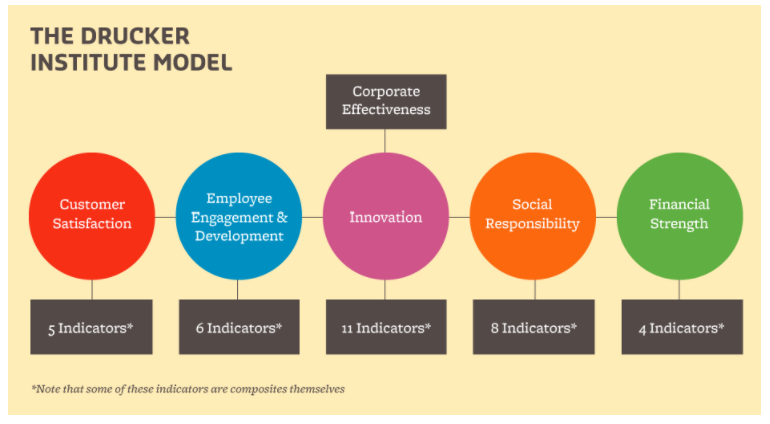
The Management Top 250 ranking, developed by the Drucker Institute, measures corporate effectiveness by examining performance in five areas: customer satisfaction, employee engagement and development, innovation, social responsibility, and financial strength.
The measure seeks to assess how well a company follows a core set of principles advanced by the late Peter Drucker, a professor, consultant, author and longtime Wall Street Journal columnist. Mr. Drucker died in 2005.
The ranking is based on an analysis of 34 data inputs provided by 14 third-party sources [see details below]. The five areas are weighted nearly equally in calculating a score that is the basis of the ranking. Not all data inputs are available for all companies in the ranking; companies are excluded from the ranking if fewer than two data inputs are available for any of the five areas.”
Top 10 is dominated by Tech companies. You can find the list below and I am very happy to see that Microsoft, my employer, is Number #1 on this list. Click on following link The Management Top 250 ranking, to discover the full list
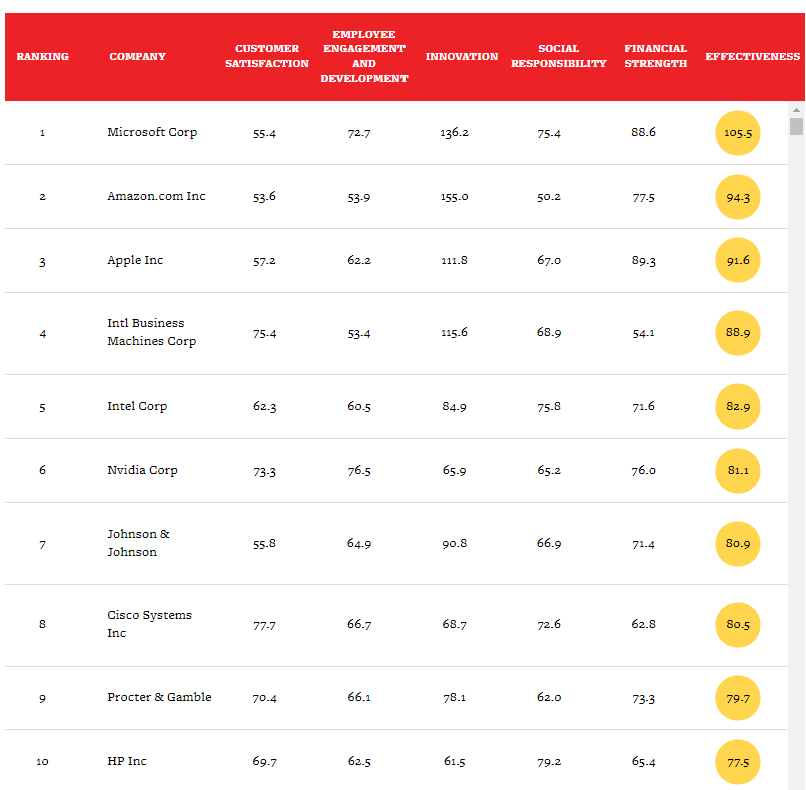
You will find below more information on how to read these data.
If you want to understand the 34 indicators, you can click on the following link: 34 indicators used in this year’s rankings
Those weights were as follows: Customer Satisfaction = 19%; Employee Engagement and Development = 19%; Innovation = 23%; Social Responsibility = 25%; and Financial Strength = 14%.
All scores are expressed as T-scores. They are standardized so that the typical range is 0 to 100, the mean is 50 and the standard deviation is 10.
If a company is one standard deviation above the mean (with a score of 60), its results are in the top 15% to 20% of a larger universe of companies that have been assessed by the Drucker Institute. If a company is one standard deviation below the mean (with a score of 40), its results fall in the bottom 15% to 20% of that larger universe.
If a company is two standard deviations above the mean (with a 70) or two standard deviations below the mean (with a 30), its results are in the top or bottom 2.5% of the larger universe. And if a company is three standard deviations above the mean (with an 80) or three standard deviations below the mean (with a 20), its results are in the top or bottom 1% of the larger universe.
The fact that a firm is ranked toward the bottom of the Management Top 250 does not mean that it is not managed effectively. The lowest-ranked firm on the list is still in the top 30% of a much larger group of companies that was analyzed.
I really want to give credit to Drucker Institute, Claremont Graduate University

 Md Consulting
Leave a comment