As previously mentioned, I am excited to share excerpts from my upcoming book. As already shared with you, I’m in the process of writing a book that deep-dives into the world of go-to-market (GTM) strategy, blending it with personal experiences and passions that have shaped my career. I will also explore how AI is impacting all of us in sales, marketing, sales enablement, operation, and finance, from insights to planning, pitching and execution. This book will give you a new and fresh perspective on building strong GTM plans, leveraging a consumer and partner-centric approach, and asking the right questions to create real differentiation and impactful storytelling. You will find below a new excerpt focusing on the structure and what you can expect. Feel free to share your thoughts on this and open a conversation with me for collaboration. My calendar shared below is fully opened for this purpose.
Please find the excerpt below.

Now that we’ve explored the components of a GTM strategy, let’s dive into why it matters so much. I’ll share some personal stories and experiences that illustrate the profound impact a well-executed GTM strategy can have, drawing parallels to the discipline and strategy required in karate.
Market Penetration: Breaking Through Barriers

A strategic GTM plan is your ticket to new markets, much like a well-executed karate technique can break through physical barriers. It provides a structured approach to understanding and entering new territories, whether they’re geographical or product based.
Early in my career, I faced the challenge of introducing a new software product to a saturated European market. The odds seemed stacked against us, reminiscent of a karate practitioner facing a seemingly insurmountable obstacle. Our GTM strategy focused on understanding the unique pain points of European businesses, tailoring our offering to address those specific needs, and leveraging local partnerships for distribution and support.
We approached this challenge with the mindset of a karateka preparing for a tournament. We studied our “opponents” (competitors), honed our “techniques” (product features), and practiced our “kata” (sales pitches) tirelessly. The result? We achieved market penetration that exceeded our wildest expectations, with adoption rates surpassing 40% in key markets within the first year.
This success was a direct result of our carefully crafted GTM strategy, which, like a well-executed karate move, allowed us to break through market barriers with precision and impact.
Brand Positioning: Finding Your Stance

GTM strategies help you carve out a unique space in the market, much like finding your optimal stance in karate. They guide how you present your brand to the world and how you differentiate yourself from competitors.
I once worked on rebranding a traditional family-owned business in the food industry. The company had a rich history but was struggling to connect with younger consumers. Our challenge was to honor the brand’s heritage while making it relevant to a new generation – a balancing act not unlike maintaining stability while executing a complex karate move.
Our GTM strategy positioned the brand not just as a food product, but as a bridge between generations, celebrating family traditions while embracing modern lifestyles. We crafted a narrative around shared meals and creating memories, tying the product to both nostalgia and contemporary experiences.
This positioning allowed us to elevate the brand above commodity competitors, justifying a premium price point and fostering strong emotional connections with consumers. The result was a 50% increase in market share among millennials and the establishment of the brand as a modern classic.
Customer Engagement: The Art of Connection
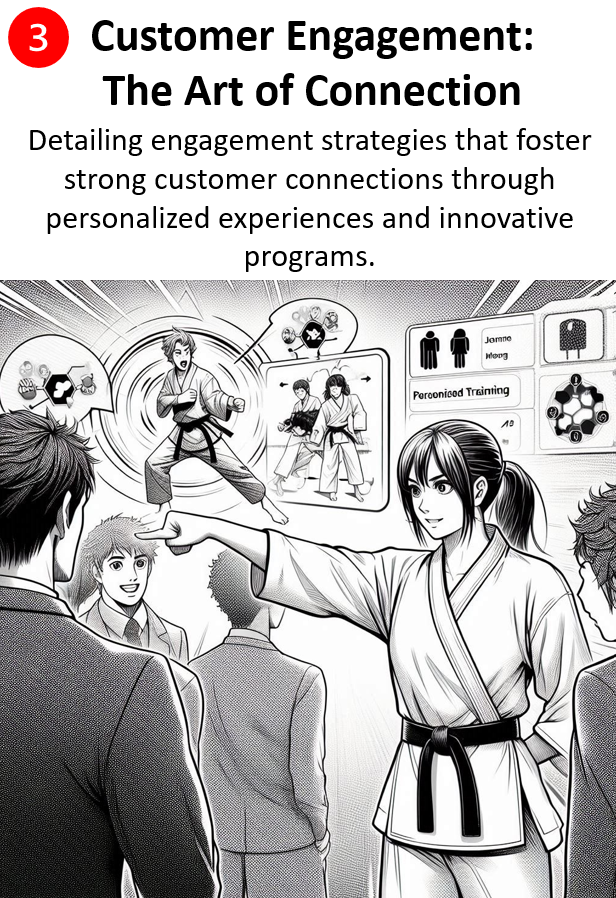
Engaging customers is at the heart of any successful GTM strategy, much like the connection between a karate master and their student. It’s about creating meaningful interactions that resonate with your audience and foster long-term relationships.
In a recent project, we faced the challenge of launching a high-tech product in a market that was traditionally slow to adopt new technologies. Our GTM strategy centered on education and experience, drawing inspiration from the way karate is taught – through demonstration, practice, and personalized guidance.
We developed an innovative “try before you buy” program, allowing potential customers to experience the product in their own environment for a month. We coupled this with personalized training sessions and a robust support system. This approach allowed customers to truly understand the value of the product and how it could improve their lives or businesses.
The result was not just increased sales, but also higher customer satisfaction and loyalty. Our Net Promoter Scores soared, and we saw a 70% conversion rate from trial to purchase – an unprecedented success in this market.
Competitive Advantage: Mastering Your Technique
A strong GTM strategy gives you a leg up on the competition, much like mastering a unique karate technique can set you apart in a tournament. It allows you to identify and leverage your unique strengths, positioning your product or service in a way that sets you apart.
I once worked with a startup that was entering a market dominated by established players. Instead of trying to compete on all fronts, our GTM strategy focused on a niche that the big players had overlooked. We positioned our product as a specialized solution for a specific industry problem, much like a karateka might focus on perfecting a particular move that others have neglected.
Our GTM approach included partnerships with industry experts, targeted content marketing to educate our niche audience, and a customer success program that ensured our solution delivered measurable ROI. This focused strategy not only drove strong initial adoption but also established the company as the go-to expert in this niche, providing a significant competitive advantage that the larger, more generalist competitors struggled to match.
Financial Impact: The Fruits of Your Labor
Ultimately, the success of a GTM strategy is reflected in the bottom line, much like the rewards of dedicated karate practice are seen in tournament victories and personal growth. A well-executed GTM plan drives revenue growth, improves profit margins, and enhances overall business performance.
Throughout my career, I’ve seen the financial impact of effective GTM strategies firsthand. In one particularly memorable instance, we were tasked with turning around a struggling product line. By focusing on strategic partnerships, innovative marketing approaches, and efficient channel management, we achieved a remarkable 200% revenue increase within just two years.
This growth wasn’t just about selling more products. Our GTM strategy allowed us to optimize our product mix, focusing on high-margin offerings and creating value-added bundles that increased average transaction values. The result was not just top-line growth, but also a significant improvement in profitability, with margins increasing from 15% to 28%.
The GTM Dojo: Practicing Your Skills

To help you visualize the potential impact of an improved GTM strategy on your business, let’s engage in a quick exercise – think of it as a training session in the GTM dojo:
- Identify your current “stance” in the market. What’s your unique value proposition?
- Assess your “opponents” (competitors). What are their strengths and weaknesses?
- Choose your “technique” (GTM approach). How can you leverage your strengths to address market needs?
- Practice your “kata” (execution plan). Map out the key steps in your GTM strategy.
- Visualize your “victory” (success metrics). What does success look like for your business?
This exercise can help you start thinking strategically about your GTM approach and quantify the potential impact on your business.
In conclusion, a well-crafted GTM strategy is not just a nice-to-have; it’s a critical component of business success. Like the discipline of karate, it requires dedication, practice, and a deep understanding of both yourself and your environment. It drives market penetration, shapes brand perception, enhances customer engagement, provides competitive advantage, and ultimately delivers significant financial impact. As we move forward in this book, we’ll explore how to craft and execute such strategies effectively, drawing on both time-tested principles and cutting-edge innovations, always with an eye towards the balance, precision, and impact exemplified in the art of karate.
Engaging with You

As part of this journey, I also want to engage with you, my readers, by sharing portions of the book. Your feedback, comments, and suggestions will be invaluable in shaping the final product. I believe in the power of co-creation and would love to incorporate any specific concepts or ideas you might have. Of course, I will give full credit to any contributions that make it into the book. I will make sure nothing confidential will be published in the book.
Join the Conversation
If you have any suggestions or would like to discuss specific concepts, feel free to connect with me on LinkedIn thru personal messaging. I’m always happy to have a conversation and explore new ideas. Together, we can create something truly special. For collaboration or project discussions, you can also schedule a conversation in my calendar below or connect with me via email at david.merzel@hotmail.com. I look forward to further discussions!

 Md Consulting
Leave a comment