
As previously mentioned, I am excited to share excerpts from my upcoming book. As already shared with you, I’m in the process of writing a book that deep-dives into the world of go-to-market (GTM) strategy, blending it with personal experiences and passions that have shaped my career. I will also explore how AI is impacting all of us in sales, marketing, sales enablement, operation, and finance, from insights to planning, pitching and execution. This book will give you a new and fresh perspective on building strong GTM plans, leveraging a consumer and partner-centric approach, and asking the right questions to create real differentiation and impactful storytelling. You will find below a new excerpt focusing on the structure and what you can expect. Feel free to share your thoughts on this and open a conversation with me for collaboration. My calendar shared below is fully opened for this purpose.
Please find the excerpt below.
As we progress in our GTM journey, establishing a solid foundation is crucial. The Yellow Belt level introduces key frameworks that form the basis of any successful GTM strategy. These foundational frameworks provide a structured approach to understanding your market, defining your business model, and analyzing your competitive position. Let’s explore each framework in detail, along with practical examples and templates.
Total Addressable Market (TAM), Serviceable Available Market (SAM), and Serviceable Obtainable Market (SOM)
Framework Overview:
The TAM, SAM, and SOM framework provides a comprehensive view of market potential, helping businesses understand their market opportunity at different levels of specificity and attainability.Template:
- Market Overview
- Total Number of Potential Customers and Average Revenue per Customer
- Key Factors Influencing Market Size
- Market Trends or Growth Projections
- TAM Calculation
- SAM Calculation
- SOM Calculation
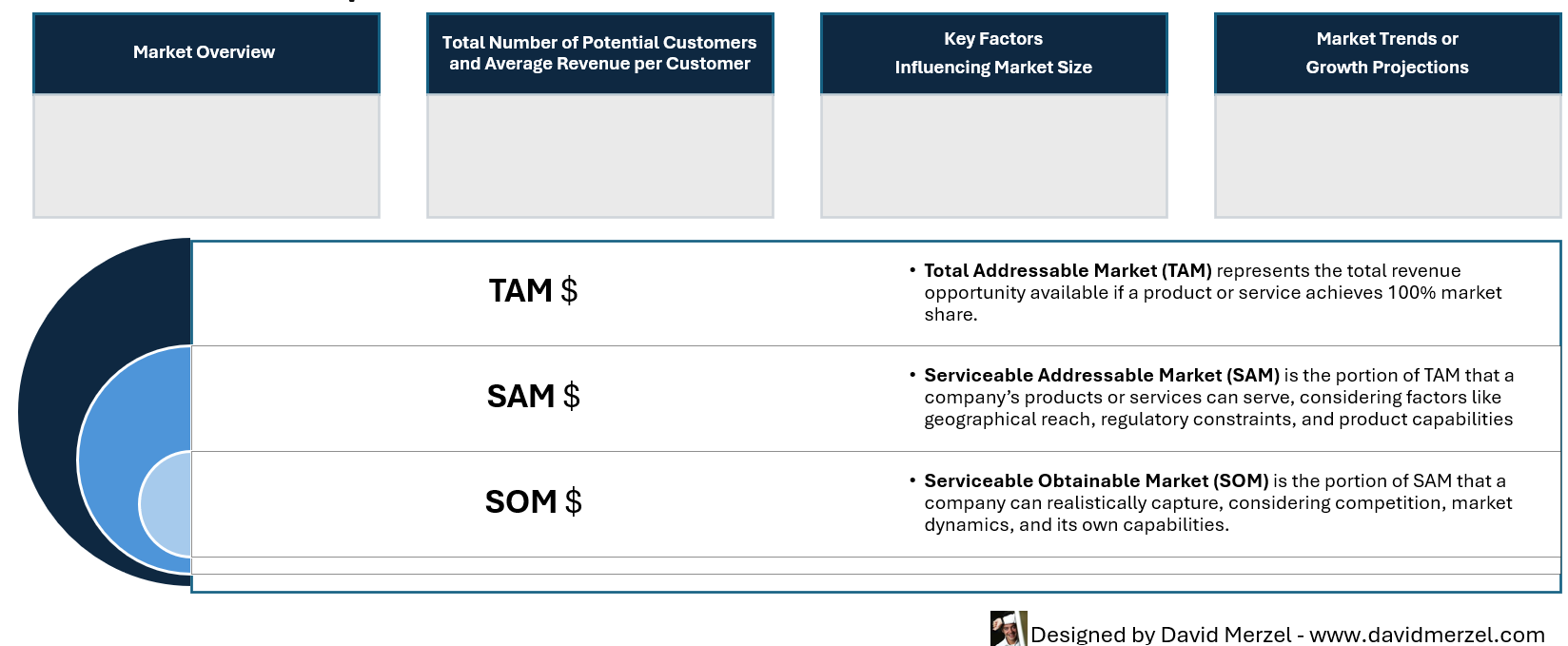
Example: Electric Scooter Market
- Market Overview:
The electric scooter market is part of the broader micro-mobility sector, addressing urban transportation needs with eco-friendly, convenient solutions. This market has seen significant growth in recent years due to increasing urbanization, environmental concerns, and the need for last-mile transportation options. - Total Number of Potential Customers and Average Revenue per Customer:
- Potential Customers: 10 million urban commuters in major cities worldwide
- Average Revenue per Customer: $300 (based on average scooter price and usage fees)
- Key Factors Influencing Market Size:
- Urbanization rates
- Environmental regulations
- Infrastructure development (e.g., bike lanes)
- Technological advancements in battery life and scooter durability
- Shift towards shared mobility services
- Market Trends or Growth Projections:
- The global electric scooter market is expected to grow at a CAGR of 7.7% from 2021 to 2028 (Grand View Research)
- Increasing adoption of dockless, app-based scooter-sharing services
- Growing investment in smart city initiatives
- TAM Calculation:
TAM = Total potential customers × Average revenue per customer
TAM = 10 million × $300 = $3 billion - SAM Calculation:
SAM focuses on the portion of TAM that fits your specific product capabilities and geographical reach.
Assuming you can serve 50% of the total market due to geographical constraints and product specifications:
SAM = 50% of TAM = $1.5 billion - SOM Calculation:
SOM represents the portion of SAM that you can realistically capture in the short to medium term.
Assuming you can capture 20% of your SAM based on your resources, competition, and go-to-market strategy:
SOM = 20% of SAM = $300 million
Source: Investopedia (https://www.investopedia.com/terms/t/total-addressable-market.asp), supplemented with industry-specific data from Grand View Research.
Market Segmentation
Framework Overview:
Market Segmentation divides the market into distinct groups with similar needs or characteristics, allowing for targeted marketing strategies.
Template:
- Geographic: Region, urban/rural, climate
- Demographic: Age, gender, income, education
- Psychographic: Lifestyle, values, interests
- Behavioral: Usage rate, brand loyalty, benefits sought

Example:
- Geographic Segments: Urban areas with high traffic congestion
- Demographic Segments: Millennials aged 25-35
- Psychographic Segments: Eco-conscious individuals valuing sustainability
- Behavioral Segments: Frequent commuters seeking cost-effective travel
Source: Kotler, P., & Armstrong, G. (2018). Principles of Marketing. Pearson.
Business Model Canvas
Framework Overview:
The Business Model Canvas is a strategic management tool used to describe, design, and analyze business models.
Template:
- Key Partners
- Key Activities
- Key Resources
- Value Propositions
- Customer Relationships
- Channels
- Customer Segments
- Cost Structure
- Revenue Streams
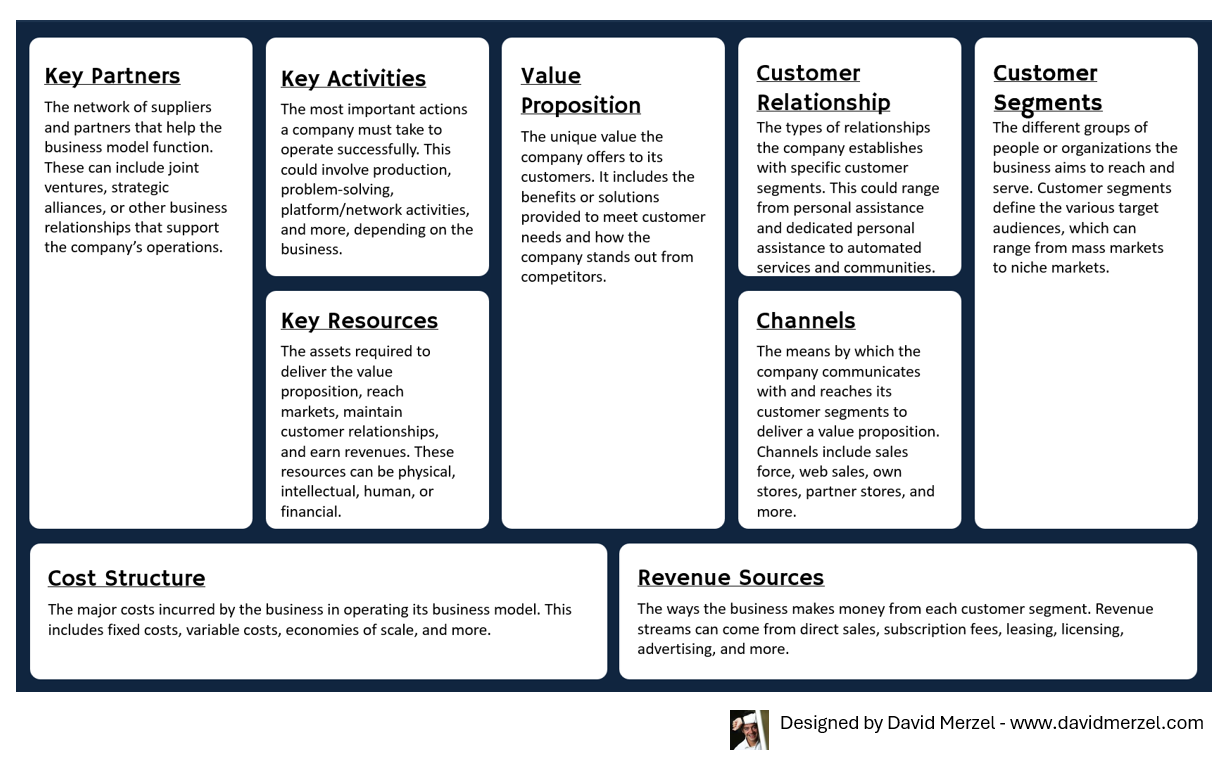
Example:
- Key Partners: Local governments, battery suppliers
- Key Activities: Manufacturing, distribution, marketing
- Key Resources: Manufacturing facilities, brand reputation
- Value Propositions: Affordable and eco-friendly transportation
- Customer Relationships: Community engagement through events
- Channels: E-commerce platform and retail partnerships
- Customer Segments: Urban commuters and students
- Cost Structure: Manufacturing costs, marketing expenses
- Revenue Streams: Direct sales and subscription services
Source: Osterwalder, A., & Pigneur, Y. (2010). Business Model Generation. Wiley.
SWOT Analysis
Framework Overview:
SWOT Analysis evaluates internal Strengths and Weaknesses and external Opportunities and Threats to inform strategic decision-making.
Template:
- Strengths: Internal positive attributes
- Weaknesses: Internal negative attributes
- Opportunities: External positive factors
- Threats: External negative factors

Example:
- Strengths: Strong brand recognition, innovative product design
- Weaknesses: Limited distribution network, high production costs
- Opportunities: Growing demand for sustainable transport solutions
- Threats: Regulatory changes, intense competition
Source: Humphrey, A. (2005). SWOT Analysis for Management Consulting. SRI Alumni Newsletter.
These foundational frameworks provide a solid base for understanding your market and crafting a competitive GTM strategy. As we progress to the Orange Belt chapter, we’ll build upon these concepts to develop more advanced market understanding and positioning strategies that leverage AI tools for deeper insights and enhanced decision-making capabilities.
By mastering these frameworks at the Yellow Belt level, you’re setting the stage for a comprehensive approach to GTM strategy that will evolve as you advance through the subsequent chapters of this book.
Citations:
[1] https://ppl-ai-file-upload.s3.amazonaws.com/web/direct-files/23985622/9a39288c-b250-4e7b-8321-9e4101a6071c/book.docx
[2] https://ppl-ai-file-upload.s3.amazonaws.com/web/direct-files/23985622/27981e06-8705-4bb0-a047-fd8091483c6f/book.docx
[3] https://ppl-ai-file-upload.s3.amazonaws.com/web/direct-files/23985622/b6204ade-e1a4-44d2-8d79-45196c59bea7/book.docx
[4] https://www.antler.co/academy/tam-sam-som
[5] https://www.seerinteractive.com/insights/marketing-sizing-with-tam-sam-som
[6] https://thinkinsights.net/consulting/tam-sam-som/
[7] https://www.techtarget.com/searchcustomerexperience/definition/TAM-SAM-SOM
Engaging with You

As part of this journey, I also want to engage with you, my readers, by sharing portions of the book. Your feedback, comments, and suggestions will be invaluable in shaping the final product. I believe in the power of co-creation and would love to incorporate any specific concepts or ideas you might have. Of course, I will give full credit to any contributions that make it into the book. I will make sure nothing confidential will be published in the book.
Join the Conversation
If you have any suggestions or would like to discuss specific concepts, feel free to connect with me on LinkedIn thru personal messaging. I’m always happy to have a conversation and explore new ideas. Together, we can create something truly special. For collaboration or project discussions, you can also schedule a conversation in my calendar below or connect with me via email at david.merzel@hotmail.com. I look forward to further discussions!

 Md Consulting
Leave a comment