
As previously mentioned, I am excited to share excerpts from my upcoming book. As already shared with you, I’m in the process of writing a book that deep-dives into the world of go-to-market (GTM) strategy, blending it with personal experiences and passions that have shaped my career. I will also explore how AI is impacting all of us in sales, marketing, sales enablement, operation, and finance, from insights to planning, pitching and execution. This book will give you a new and fresh perspective on building strong GTM plans, leveraging a consumer and partner-centric approach, and asking the right questions to create real differentiation and impactful storytelling. You will find below a new excerpt focusing on the structure and what you can expect. Feel free to share your thoughts on this and open a conversation with me for collaboration. My calendar shared below is fully opened for this purpose.
Please find the excerpt below.
As we progress to the Orange Belt level, we delve deeper into more sophisticated frameworks that enhance our market understanding and strategic positioning. Building upon the foundational concepts introduced in the Yellow Belt chapter, these advanced frameworks provide a more nuanced and comprehensive approach to developing our Go-To-Market (GTM) strategy.
In this section, we’ll explore four key frameworks: Persona Development, Jobs to Be Done (JTBD), Value Proposition Canvas, and Porter’s Five Forces. Each of these frameworks offers unique insights that can significantly improve our ability to understand our target market, align our products with customer needs, and position ourselves effectively in the competitive landscape.
Just like we did for the Yellow Belt, we’ll dive into understanding your audience and refining your value proposition using a fictional case: launching new sustainable running shoes. The prompts above are great starting points for conversations with ChatGPT or other LLMs. Always add your specific content and iterate to get the best results. Remember, ChatGPT won’t replace your reasoning and creativity. Use this as a solid foundation to explore the different modes below.
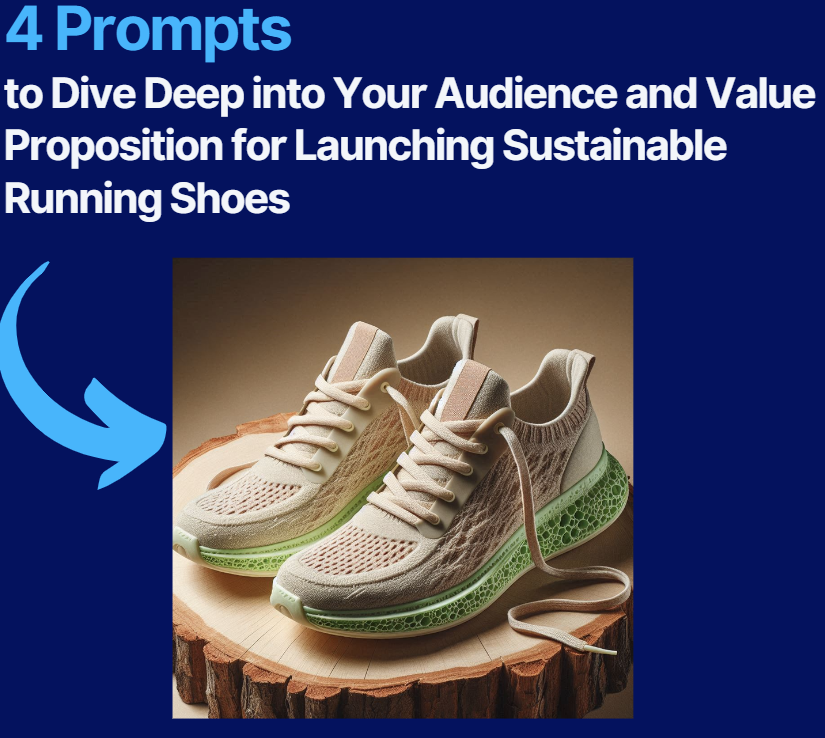
Moreover, we’ll discuss how AI can be leveraged to enhance the application of these frameworks, introducing the concept of an Orange Belt GTM AI Agent that can assist in these more complex analyses.
Below, you’ll find an infographic that summarizes the four prompts we’ll discuss in this section. Further details are provided afterward.

Persona Development
Persona Development is a crucial step in understanding our target audience at a deeper level. It goes beyond basic demographics to create a vivid, detailed profile of our ideal customer.
Framework Overview:
This framework helps us create a fictional character that represents our target customer. It includes not just demographic information, but also psychographic details such as goals, challenges, values, and fears.
AI-Enhanced Approach:
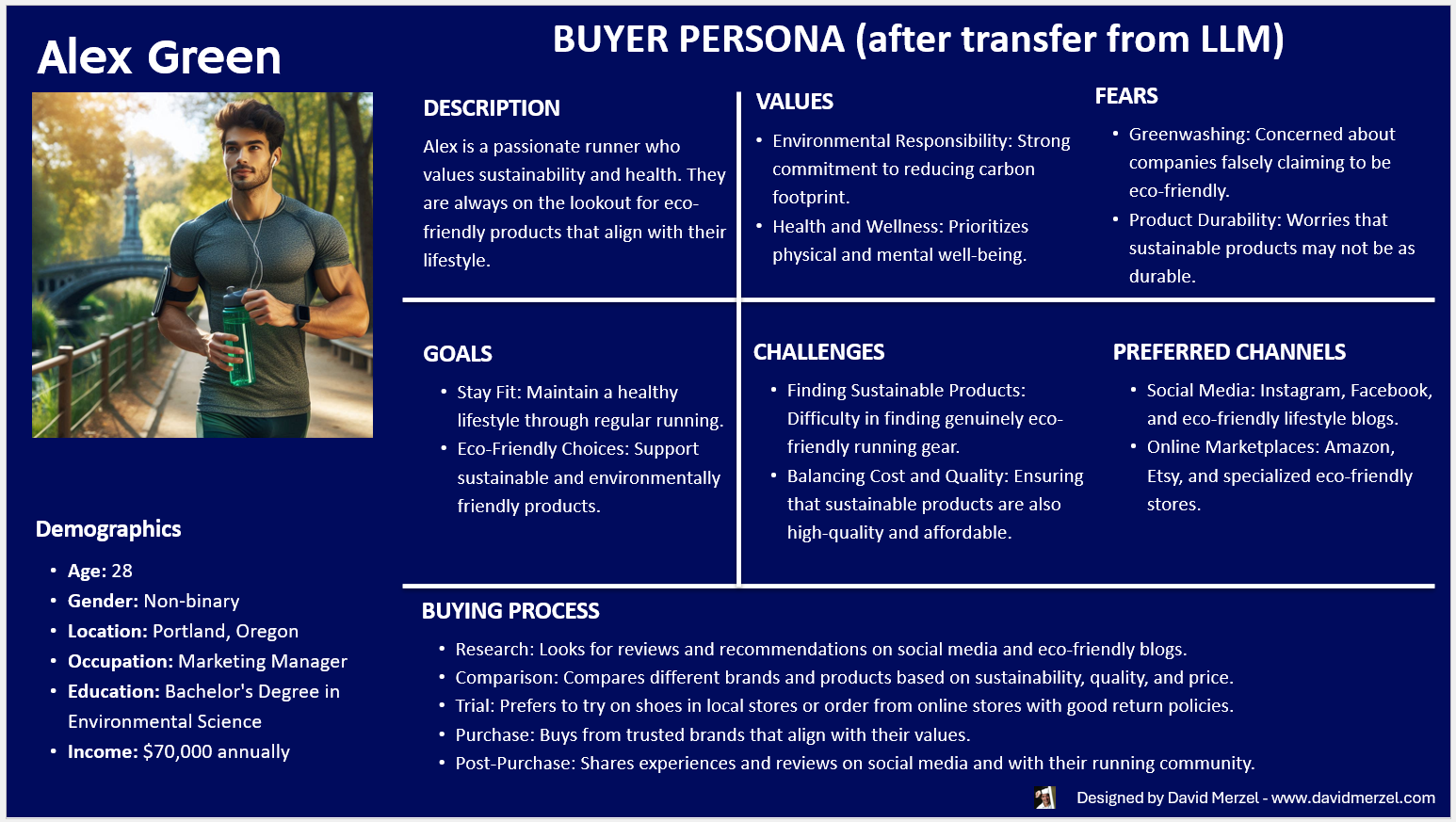
To create a detailed buyer persona for our sustainable running shoes, we can use the following prompt with an AI language model:
“Create a detailed buyer persona for our sustainable running shoes. Include a name, photo description, demographics, goals, challenges, values, fears, preferred channels, and buying process. Focus on an eco-conscious millennial runner.”
Template:
Buyer Persona: [Name]
[Space for photo or photo description]
- Demographics
- Goals
- Challenges
- Values
- Fears
- Preferred Channels
- Buying Process
Source: Revella, A. (2015). Buyer Personas: How to Gain Insight into your Customer’s Expectations, Align your Marketing Strategies, and Win More Business. Wiley.
Example output
Jobs to Be Done (JTBD)
The Jobs to Be Done framework shifts our focus from the product itself to the underlying job that the customer is trying to accomplish.
Framework Overview:
This approach helps us understand the functional, emotional, and social dimensions of the customer’s needs, as well as the constraints they face and the outcomes they desire.
AI-Enhanced Approach:
To analyze the Jobs to Be Done for our sustainable running shoes, we can use the following prompt:
“Analyze the Jobs to Be Done for our sustainable running shoes. Identify the functional, emotional, and social aspects of the job, as well as any constraints and desired outcomes. Focus on the perspective of an eco-conscious runner.”
Template:
Jobs to Be Done Analysis: Sustainable Running Shoes
- Functional Job Aspects
- Emotional Job Aspects
- Social Job Aspects
- Job Constraints
- Desired Outcomes
Source: Christensen, C. M., Hall, T., Dillon, K., & Duncan, D. S. (2016). Know Your Customers’ “Jobs to Be Done”. Harvard Business Review.
Example output

Value Proposition Canvas
The Value Proposition Canvas helps us ensure that our product or service is positioned around what the customer values and needs.
Framework Overview:
This tool is split into two parts: the Customer Profile, which clarifies our customer understanding, and the Value Map, which describes how we intend to create value for that customer.
AI-Enhanced Approach:
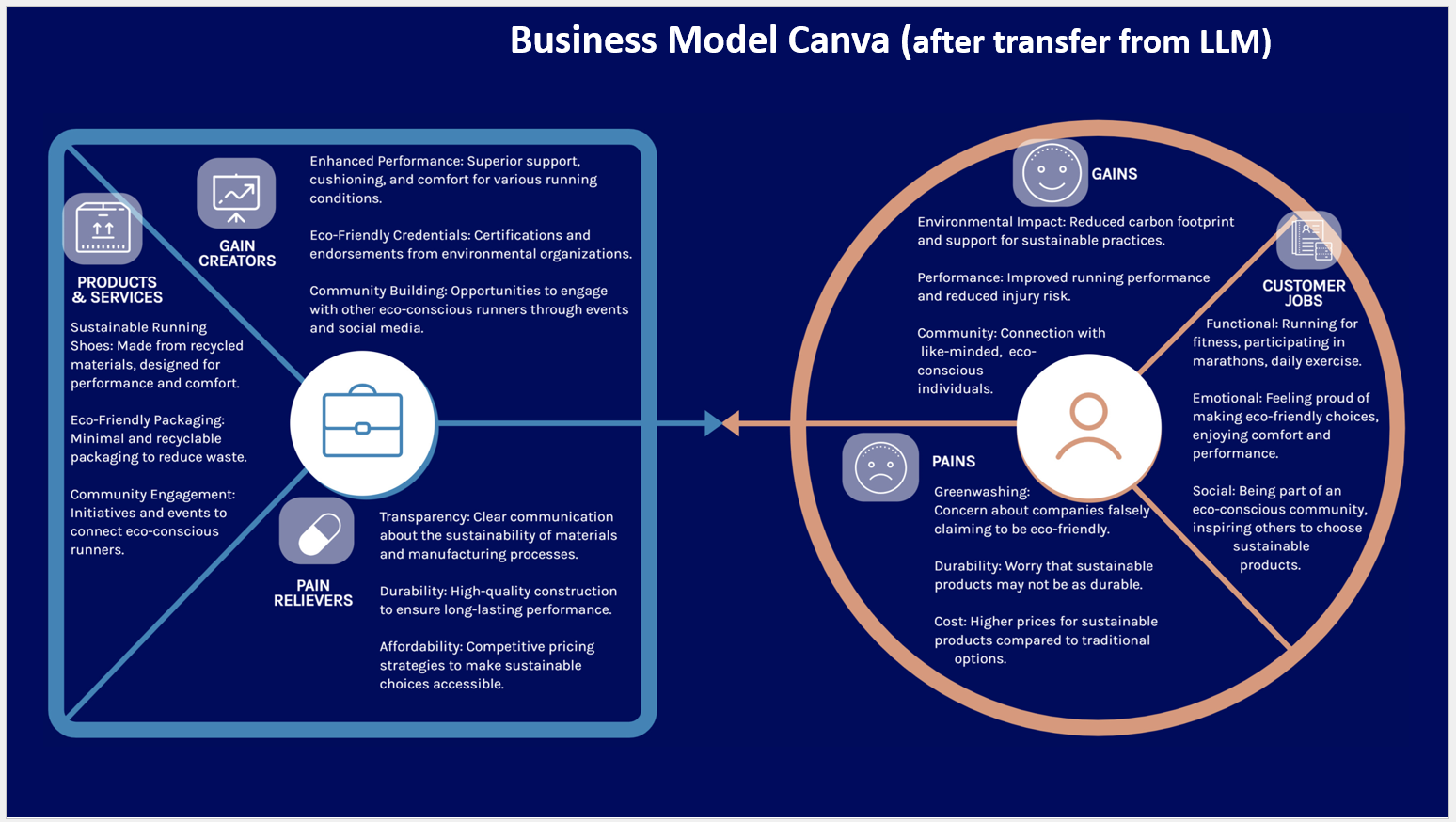
To create a Value Proposition Canvas for our sustainable running shoes, we can use the following prompt:
“Create a Value Proposition Canvas for our sustainable running shoes. Include customer jobs, pains, and gains in the customer profile. For the value map, list our products & services, pain relievers, and gain creators.”
Template:
Value Proposition Canvas: Sustainable Running Shoes
- Customer Profile
- Customer Jobs
- Pains
- Gains:
- Value Map:
- Products & Services:
- Pain Relievers:
- Gain Creators:
Source: Osterwalder, A., Pigneur, Y., Bernarda, G., & Smith, A. (2014). Value Proposition Design. Wiley.
Example output
Porter’s Five Forces
Porter’s Five Forces is a powerful tool for understanding the competitive forces within an industry.
Framework Overview:
This framework helps us analyze the level of competition within an industry by examining five key forces: the threat of new entrants, bargaining power of suppliers, bargaining power of buyers, threat of substitute products or services, and rivalry among existing competitors.
AI-Enhanced Approach:
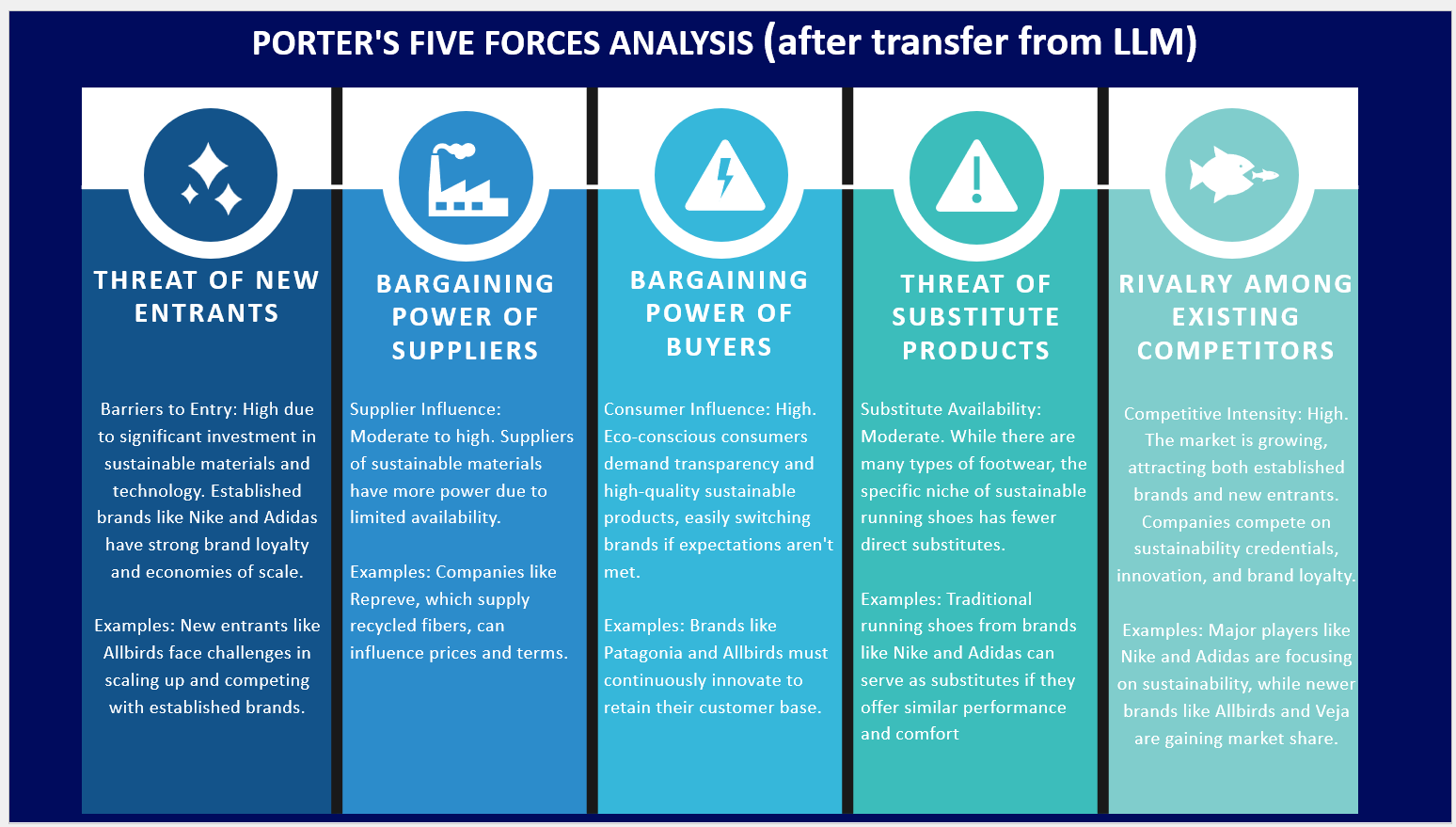
To conduct a Porter’s Five Forces analysis for the sustainable running shoes market, we can use the following prompt:
“Conduct a Porter’s Five Forces analysis for the sustainable running shoes market. Assess the threat of new entrants, bargaining power of suppliers and buyers, threat of substitute products, and rivalry among existing competitors. Provide specific examples and explanations for each force.”
Template:
Porter’s Five Forces Analysis: Sustainable Running Shoes Market
Threat of New Entrants:
- Level: [High/Medium/Low]
- Explanation: [LLM output]
- Examples: [LLM output]
Bargaining Power of Suppliers:
- Level: [High/Medium/Low]
- Explanation: [LLM output]
- Examples: [LLM output]
Bargaining Power of Buyers:
- Level: [High/Medium/Low]
- Explanation: [LLM output]
- Examples: [LLM output]
Threat of Substitute Products or Services:
- Level: [High/Medium/Low]
- Explanation: [LLM output]
- Examples: [LLM output]
Rivalry Among Existing Competitors:
- Level: [High/Medium/Low]
- Explanation: [LLM output]
- Examples: [LLM output]
Source: Porter, M. E. (1979). How Competitive Forces Shape Strategy. Harvard Business Review.
Example output
Orange Belt GTM AI Agent
As we advance to the Orange Belt level, we can leverage more sophisticated AI agents to assist with these advanced frameworks. This Orange Belt GTM AI Agent would be designed to handle more complex analyses and provide deeper insights, transforming how we approach market understanding and positioning.
Capabilities of the Orange Belt GTM AI Agent:
- Advanced Data Analysis: The agent processes large amounts of market data, customer feedback, and competitive intelligence to inform our frameworks.
- Multi-Framework Integration: It synthesizes insights across different frameworks, showing how persona characteristics relate to Jobs to Be Done, or how the Value Proposition Canvas aligns with Porter’s Five Forces analysis.
- Predictive Modeling: Using historical data and market trends, the agent predicts future shifts in customer needs or competitive landscapes.
- Natural Language Processing: It analyzes customer reviews, social media posts, and other unstructured data to inform persona development and JTBD analysis.
- Visualization: The agent creates visual representations of the frameworks, making complex data more accessible and actionable.
- Scenario Planning: It generates multiple scenarios based on different market conditions or strategic choices, helping strategists prepare for various outcomes.
- Continuous Learning: The agent updates its analyses in real-time as new data becomes available, ensuring that the GTM strategy remains current and relevant.
By leveraging such an AI agent, we can enhance our ability to apply these advanced frameworks effectively, leading to more robust and insightful GTM strategies. The AI agent can help us gain deeper market insights, define target audiences more precisely, and position products more effectively in the market.
For example, when developing personas, the AI agent can analyze vast amounts of customer data to identify patterns and trends that humans might miss. For JTBD analysis, it can process customer feedback from multiple channels to uncover hidden needs and desires. In creating the Value Proposition Canvas, the AI can suggest innovative pain relievers and gain creators based on market trends and competitor analysis.
However, it’s crucial to remember that while AI can provide valuable assistance, human judgment and creativity remain essential in interpreting the results and making strategic decisions. The AI agent should be seen as a powerful tool that augments human capabilities, not replaces them.
As we continue our journey through the belts, we’ll see how these advanced frameworks and AI capabilities can be applied to create even more sophisticated and effective GTM strategies. In the next chapters, we’ll explore how AI is transforming customer engagement, marketing efforts, and sales processes throughout the customer lifecycle, further revolutionizing our approach to GTM strategy.
Hands-On Exercise: EcoWear GTM Strategy – Advanced Market Understanding and Positioning
Scenario:
You are the product manager for “EcoWear,” an innovative line of smart clothing made from sustainable materials. These garments not only promote eco-friendliness but also incorporate wearable technology to monitor health metrics such as heart rate, temperature, and activity levels. Your task is to develop a comprehensive market understanding and positioning strategy using the four frameworks discussed in the Orange Belt chapter.Exercise Steps:
- Buyer Persona Development:
Create a detailed buyer persona for EcoWear’s primary target customer. Include demographics, psychographics, goals, challenges, values, fears, and buying behavior. - Jobs to Be Done (JTBD) Analysis:
Identify and analyze at least three key jobs that EcoWear helps customers accomplish. For each job, describe the functional, emotional, and social aspects, as well as any constraints and desired outcomes. - Value Proposition Canvas:
Complete a Value Proposition Canvas for EcoWear. In the customer profile, list customer jobs, pains, and gains. In the value map, detail your products & services, pain relievers, and gain creators. - Porter’s Five Forces Analysis:
Conduct a Porter’s Five Forces analysis for the smart clothing market, focusing on EcoWear’s unique position. Provide a brief explanation and rate the intensity (High/Medium/Low) for each force. - Integration and Strategy Formulation:
Based on the insights from the four models, develop a short positioning statement for EcoWear and outline three key strategic initiatives to enhance your market position. - AI Enhancement:
Propose one way that AI could be used to enhance or automate part of your analysis for each of the four models.
Deliverables:
- A one-page buyer persona profile
- A table outlining three Jobs to Be Done
- A completed Value Proposition Canvas
- A summary of Porter’s Five Forces analysis
- A positioning statement and three strategic initiatives (300 words max)
- A list of AI enhancement ideas for each model
Suggested Time Allocation:
- Buyer Persona Development: 20 minutes
- Jobs to Be Done Analysis: 20 minutes
- Value Proposition Canvas: 25 minutes
- Porter’s Five Forces Analysis: 20 minutes
- Integration and Strategy Formulation: 20 minutes
- AI Enhancement Ideas: 15 minutes
Total Time: 2 hours.
This exercise allows participants to apply all four models from the Orange Belt chapter in a cohesive, practical scenario centered around an inspirational product that embodies sustainability and innovation. It encourages strategic thinking, market analysis, and integration of multiple frameworks while also considering how AI can enhance their strategies.
Citations:
[1] https://ppl-ai-file-upload.s3.amazonaws.com/web/direct-files/23985622/38806b67-8d79-49a2-99f8-5330a1b7a762/book.docx
[2] https://ppl-ai-file-upload.s3.amazonaws.com/web/direct-files/23985622/9a39288c-b250-4e7b-8321-9e4101a6071c/book.docx
[3] https://ppl-ai-file-upload.s3.amazonaws.com/web/direct-files/23985622/9f1ed15e-2350-4c71-83c6-f095bf42a388/Book-Templates-Yellow-Belt.pptx
Engaging with You

As part of this journey, I also want to engage with you, my readers, by sharing portions of the book. Your feedback, comments, and suggestions will be invaluable in shaping the final product. I believe in the power of co-creation and would love to incorporate any specific concepts or ideas you might have. Of course, I will give full credit to any contributions that make it into the book. I will make sure nothing confidential will be published in the book.
Join the Conversation
If you have any suggestions or would like to discuss specific concepts, feel free to connect with me on LinkedIn thru personal messaging. I’m always happy to have a conversation and explore new ideas. Together, we can create something truly special. For collaboration or project discussions, you can also schedule a conversation in my calendar below or connect with me via email at david.merzel@hotmail.com. I look forward to further discussions!

 Md Consulting
Leave a comment