
As previously mentioned, I am excited to share excerpts from my upcoming book. As already shared with you, I’m in the process of writing a book that deep-dives into the world of go-to-market (GTM) strategy, blending it with personal experiences and passions that have shaped my career. I will also explore how AI is impacting all of us in sales, marketing, sales enablement, operation, and finance, from insights to planning, pitching and execution. This book will give you a new and fresh perspective on building strong GTM plans, leveraging a consumer and partner-centric approach, and asking the right questions to create real differentiation and impactful storytelling. You will find below a new excerpt focusing on the structure and what you can expect. Feel free to share your thoughts on this and open a conversation with me for collaboration. My calendar shared below is fully opened for this purpose.
Please find the excerpt below.
As we progress to the Green Belt level, we delve deeper into frameworks that enhance customer engagement and marketing effectiveness. Building upon the market understanding developed in previous levels, these advanced frameworks provide a more nuanced and comprehensive approach to connecting with customers throughout their journey.
In this section, we’ll explore four key frameworks: Customer Journey Map, AIDA Model, AARRR (Pirate Metrics) Model, and Net Promoter Score (NPS). Each of these frameworks offers unique insights that can significantly improve our ability to engage customers, optimize marketing efforts, and drive business growth.
Moreover, we’ll discuss how AI can be leveraged to enhance the application of these frameworks, introducing the concept of a Green Belt GTM AI Agent that can assist in these more complex customer engagement strategies.
Customer Journey Map
The Customer Journey Map is a powerful tool that visualizes the entire process a customer goes through when engaging with your company, product, or service.
Framework Overview:
This framework helps us understand the customer’s experience at every touchpoint, from initial awareness to post-purchase advocacy. It includes the customer’s actions, emotions, pain points, and opportunities for improvement at each stage.
AI-Enhanced Approach:
To create a detailed Customer Journey Map for sustainable running shoes, we can use the following prompt with an AI language model:
“Create a comprehensive Customer Journey Map for a line of sustainable running shoes. Include the stages of Awareness, Consideration, Purchase, Retention, and Advocacy. For each stage, describe customer actions, touchpoints, emotions, pain points, and opportunities for improvement. Focus on the unique aspects of eco-friendly materials and performance features.”
Template:
Customer Journey Map: Sustainable Running Shoes
Stages:
- Awareness
- Consideration
- Purchase
- Retention
- Advocacy
For each stage:
- Customer Actions: [LLM output]
- Touchpoints: [LLM output]
- Emotions: [LLM output]
- Pain Points: [LLM output]
- Opportunities: [LLM output]
Source: Lemon, K. N., & Verhoef, P. C. (2016). Understanding Customer Experience Throughout the Customer Journey. Journal of Marketing.
Below, you’ll find the template completed after executing the LLM with the specified prompt.

AIDA Model
The AIDA Model is a classic marketing framework that describes the stages a customer goes through in the purchasing process.
Framework Overview:
This approach helps us understand and optimize each stage of the customer’s decision-making process, from initial attention to final action.
AI-Enhanced Approach:
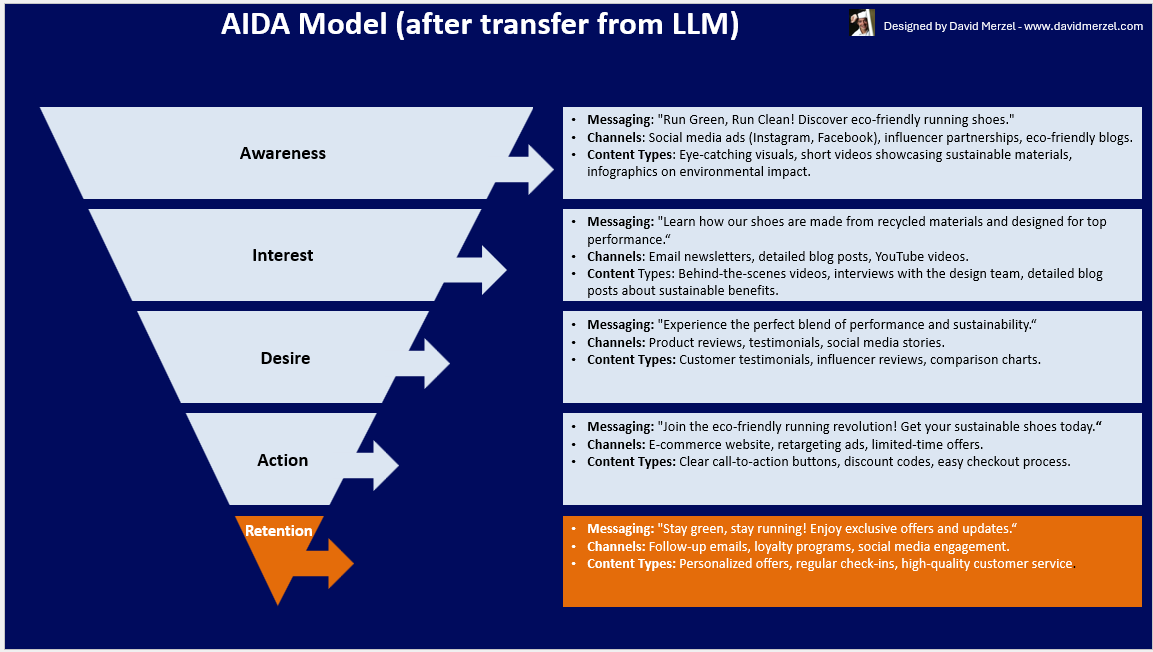
To apply the AIDA model to sustainable running shoes marketing strategy, we can use the following prompt:
“Apply the AIDA model to a sustainable running shoes marketing strategy. For each stage (Attention, Interest, Desire, Action), describe specific tactics that would appeal to eco-conscious runners. Include examples of messaging, channels, and content types for each stage.”
Template:
AIDA Model: Sustainable Running Shoes Marketing Strategy
- Attention: [LLM output]
- Interest: [LLM output]
- Desire: [LLM output]
- Action: [LLM output]
Source: Strong, E. K. (1925). The Psychology of Selling and Advertising. McGraw-Hill.
The template, filled in after running the LLM with the aforementioned prompt, is provided below
AARRR (Pirate Metrics) Model
The AARRR Model, also known as Pirate Metrics, is a framework that focuses on key metrics for growth hacking and customer lifecycle management.
Framework Overview:
This model helps us track and optimize five key stages of the customer lifecycle: Acquisition, Activation, Retention, Referral, and Revenue.
AI-Enhanced Approach:
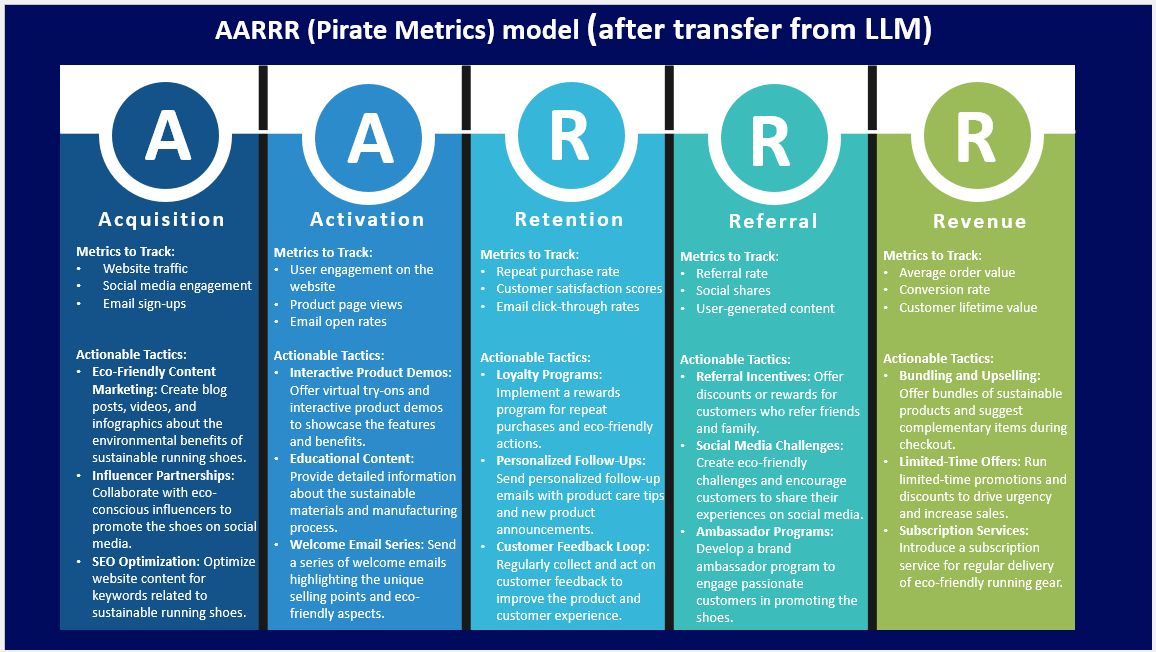
To develop a growth hacking strategy for sustainable running shoes using the AARRR model, we can use the following prompt:
“Develop a growth hacking strategy for a line of sustainable running shoes using the AARRR (Pirate Metrics) model. For each stage (Acquisition, Activation, Retention, Referral, Revenue), propose specific metrics to track and actionable tactics to improve performance. Focus on leveraging the eco-friendly aspects and performance features of the product.”
Template:
AARRR Model: Sustainable Running Shoes Growth Strategy
- Acquisition: [LLM output]
- Activation: [LLM output]
- Retention: [LLM output]
- Referral: [LLM output]
- Revenue: [LLM output]
Source: McClure, D. (2007). Startup Metrics for Pirates. 500 Hats.
You can see the template below, which has been filled in following the execution of the LLM with the given prompt.
Net Promoter Score (NPS)
The Net Promoter Score is a widely used metric for measuring customer experience and predicting business growth.
Framework Overview:
This approach helps us gauge customer satisfaction and loyalty by asking a simple question about their likelihood to recommend the product or service.
AI-Enhanced Approach:
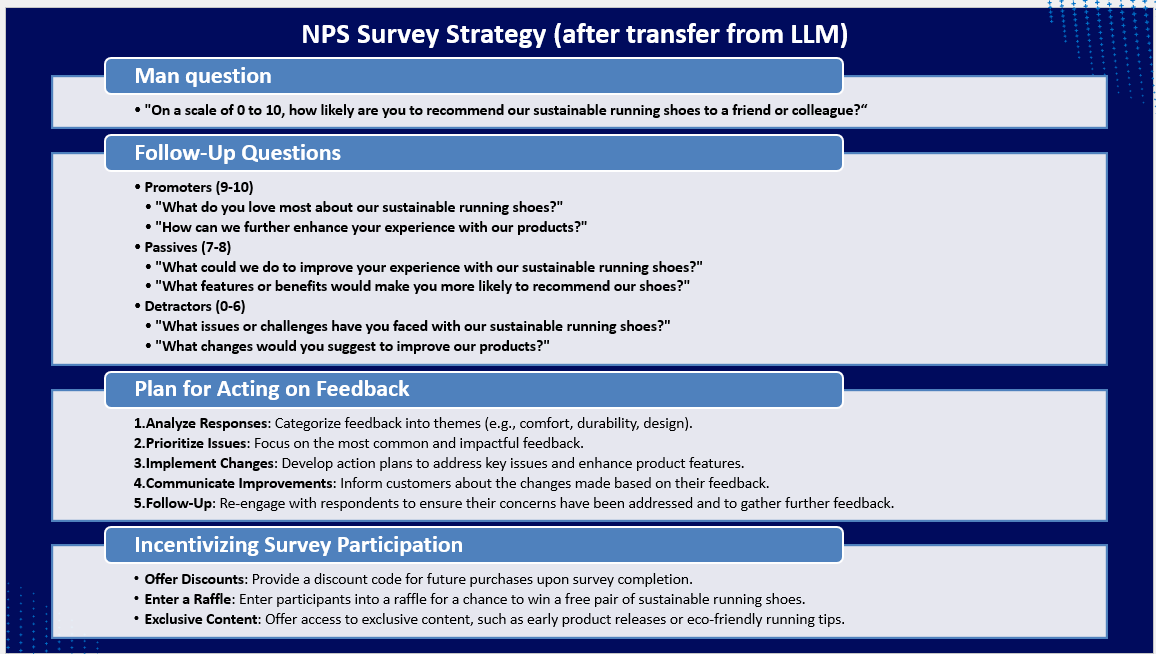
To design an NPS survey strategy for sustainable running shoes, we can use the following prompt:
“Design an NPS survey strategy for a line of sustainable running shoes. Include the main survey question, follow-up questions for each category (Promoters, Passives, Detractors), and a plan for how to act on the feedback received. Also, suggest ways to incentivize survey participation without biasing the results.”
Template:
Net Promoter Score Survey: Sustainable Running Shoes
Main Question: [LLM output]
Follow-up Questions:
- Promoters (9-10): [LLM output]
- Passives (7-8): [LLM output]
- Detractors (0-6): [LLM output]
Action Plan: [LLM output]
Incentive Strategy: [LLM output]
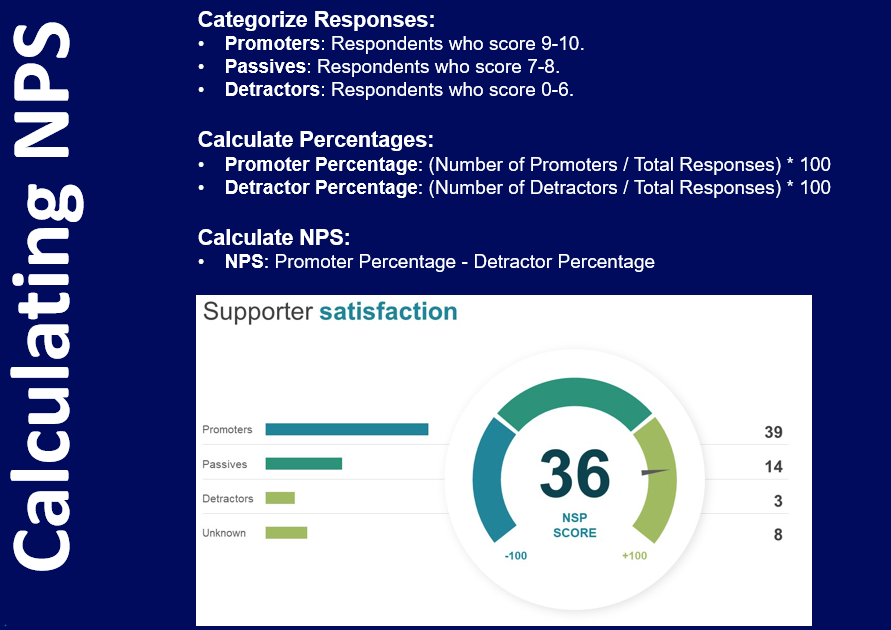
NPS Calculation: NPS = % Promoters – % Detractors
Source: Reichheld, F. F. (2003). The One Number You Need to Grow. Harvard Business Review.
After running the LLM with the prompt mentioned above, the filled-in template is shown below.
You will also find below more details on how to calculate the NPS
Green Belt GTM AI Agent
As we advance to the Green Belt level, we can envision a more sophisticated AI agent that can assist with these advanced customer engagement frameworks. This Green Belt GTM AI Agent would be designed to handle more complex analyses and provide deeper insights into customer behavior and engagement strategies.
Capabilities of the Green Belt GTM AI Agent:
- Customer Journey Mapping: The agent could analyze customer data from various touchpoints to automatically generate and update customer journey maps for sustainable running shoes, identifying key moments of truth and areas for improvement.
- AIDA Model Optimization: It could analyze marketing campaign performance data to suggest improvements for each stage of the AIDA model, optimizing messaging and channel selection for eco-conscious runners.
- Growth Hacking with AARRR: The agent could continuously monitor and analyze metrics for each stage of the AARRR model, suggesting data-driven tactics to improve performance in real-time for the sustainable running shoes line.
- NPS Analysis and Action Planning: It could process NPS survey responses, including open-ended feedback, to identify trends and suggest specific actions to improve customer satisfaction and loyalty for sustainable running shoes.
- Cross-Framework Integration: The agent could synthesize insights across all four frameworks, providing a holistic view of customer engagement and suggesting integrated strategies for the sustainable running shoes brand.
- Predictive Customer Behavior Modeling: Using historical data and machine learning algorithms, the agent could predict future customer behavior and suggest proactive engagement strategies for eco-conscious runners.
- Real-time Personalization: The agent could leverage real-time data to personalize customer interactions across various touchpoints, enhancing the overall customer experience for sustainable running shoe buyers.
By leveraging such an AI agent, we can enhance our ability to apply these advanced frameworks effectively, leading to more robust and insightful customer engagement strategies. The AI agent can help us gain deeper insights into customer behavior, optimize marketing efforts, and drive business growth through improved customer satisfaction and loyalty.
As we continue our journey through the belts, we’ll see how these advanced frameworks and AI capabilities can be applied to create even more sophisticated and effective GTM strategies. In the next chapter, we’ll explore how to integrate these customer engagement insights with broader business strategies, ensuring that our GTM efforts are aligned with overall business objectives and driving sustainable growth.
Remember, as we’ve learned from our karate journey, the path to mastery is ongoing. Each belt represents not just new knowledge, but a deeper understanding of how to apply that knowledge effectively. As we progress to the Green Belt level, we’re not just learning new frameworks, but developing a more nuanced and integrated approach to GTM strategy. The AI agents we’re introducing are not meant to replace human creativity and intuition, but to augment and enhance our capabilities, allowing us to focus on higher-level strategic thinking and decision-making.
In the spirit of continuous improvement that we discussed in the White Belt chapter, I encourage you to approach these frameworks and AI tools with both curiosity and critical thinking. Experiment with them, adapt them to your specific context, and always be open to learning and refining your approach. The journey to GTM mastery is ongoing, and each new tool and framework we master brings us one step closer to achieving our Ikigai – our reason for being – in the business world.
Certainly! I’ll add the hands-on exercise we discussed previously at the end of the Green Belt section. Here’s the updated content with the exercise included:
[The previous content remains the same, and then we add:]
Hands-On Exercise: SolarSip GTM Strategy
To help you apply the concepts we’ve covered in this chapter, let’s engage in a practical exercise. This hands-on activity will allow you to put your newfound knowledge into action and develop a comprehensive customer engagement and marketing strategy.
Scenario:
You are the marketing manager for “SolarSip,” a new brand launching an innovative solar-powered reusable water bottle. This bottle uses solar energy to purify water and keep it at an optimal temperature. Your task is to develop a comprehensive customer engagement and marketing strategy using the four frameworks we’ve discussed in the Green Belt chapter.
Exercise Steps:
- Customer Journey Map:
Create a customer journey map for a potential SolarSip customer, from initial awareness to becoming a brand advocate. Include at least three touchpoints for each stage (Awareness, Consideration, Purchase, Retention, and Advocacy). - AIDA Model:
Develop a marketing campaign using the AIDA model. For each stage (Attention, Interest, Desire, Action), describe one specific marketing tactic you would use to promote SolarSip bottles. - AARRR (Pirate Metrics) Model:
Identify one key metric and one strategy for improvement for each stage of the AARRR model in the context of SolarSip:
- Acquisition
- Activation
- Retention
- Referral
- Revenue
- Net Promoter Score (NPS):
Design an NPS survey for SolarSip customers. Write the main NPS question and two follow-up questions each for Promoters, Passives, and Detractors. - Integration:
Explain how you would integrate insights from the NPS survey into your Customer Journey Map and AARRR strategies. Provide at least two specific examples. - AI Enhancement:
Propose one way that AI could be used to enhance or automate part of your strategy for each of the four models.
Deliverables:
- A visual customer journey map
- A table outlining your AIDA marketing campaign
- A table showing AARRR metrics and strategies
- Your NPS survey questions
- A short paragraph on integration (200 words max)
- A list of AI enhancement ideas
Suggested Time Allocation:
- Customer Journey Map: 30 minutes
- AIDA Model: 20 minutes
- AARRR (Pirate Metrics) Model: 25 minutes
- Net Promoter Score (NPS): 15 minutes
- Integration: 15 minutes
- AI Enhancement: 15 minutes
Total Time: 2 hours
This exercise allows you to apply all four models from the Green Belt chapter in a cohesive, practical scenario. It encourages creative thinking, strategic planning, and the integration of multiple frameworks. The AI enhancement component also ties back to the book’s overall theme of leveraging technology in GTM strategies.
Remember, the goal of this exercise is not just to complete each step, but to think critically about how these frameworks interact and complement each other. As you work through the exercise, consider how each decision you make in one framework might impact the others. This holistic thinking is key to developing a robust and effective GTM strategy.
Good luck, and enjoy the process of bringing SolarSip to market!
Citations:
[1] https://ppl-ai-file-upload.s3.amazonaws.com/web/direct-files/23985622/b8f22697-6df4-4704-83f0-79d793f15ac2/book.docx
[2] https://ppl-ai-file-upload.s3.amazonaws.com/web/direct-files/23985622/38806b67-8d79-49a2-99f8-5330a1b7a762/book.docx
[3] https://ppl-ai-file-upload.s3.amazonaws.com/web/direct-files/23985622/9a39288c-b250-4e7b-8321-9e4101a6071c/book.docx
Engaging with You

As part of this journey, I also want to engage with you, my readers, by sharing portions of the book. Your feedback, comments, and suggestions will be invaluable in shaping the final product. I believe in the power of co-creation and would love to incorporate any specific concepts or ideas you might have. Of course, I will give full credit to any contributions that make it into the book. I will make sure nothing confidential will be published in the book.
Join the Conversation
If you have any suggestions or would like to discuss specific concepts, feel free to connect with me on LinkedIn thru personal messaging. I’m always happy to have a conversation and explore new ideas. Together, we can create something truly special. For collaboration or project discussions, you can also schedule a conversation in my calendar below or connect with me via email at david.merzel@hotmail.com. I look forward to further discussions!

 Md Consulting
Leave a comment