
As previously mentioned, I am excited to share excerpts from my upcoming book. As already shared with you, I’m in the process of writing a book that deep-dives into the world of go-to-market (GTM) strategy, blending it with personal experiences and passions that have shaped my career. I will also explore how AI is impacting all of us in sales, marketing, sales enablement, operation, and finance, from insights to planning, pitching and execution. This book will give you a new and fresh perspective on building strong GTM plans, leveraging a consumer and partner-centric approach, and asking the right questions to create real differentiation and impactful storytelling. You will find below a new excerpt focusing on the structure and what you can expect. Feel free to share your thoughts on this and open a conversation with me for collaboration. My calendar shared below is fully opened for this purpose.
Please find the excerpt below.
As we progress to the Blue Belt level in our GTM journey, we delve deeper into the crucial aspects of distribution strategies and pricing models. Building on the customer engagement insights from the Green Belt, these advanced frameworks will help you optimize your distribution channels and develop effective pricing strategies that align with your overall GTM approach.
In this section, we’ll explore four key frameworks: Distribution Channel Strategy, Multichannel Marketing Framework, Price Elasticity of Demand, and Value-Based Pricing. Each of these frameworks offers unique insights that can significantly improve your ability to reach customers effectively and price your products optimally.
Moreover, we’ll discuss how AI can be leveraged to enhance the application of these frameworks, introducing the concept of a Blue Belt GTM AI Agent that can assist in these more complex distribution and pricing strategies.
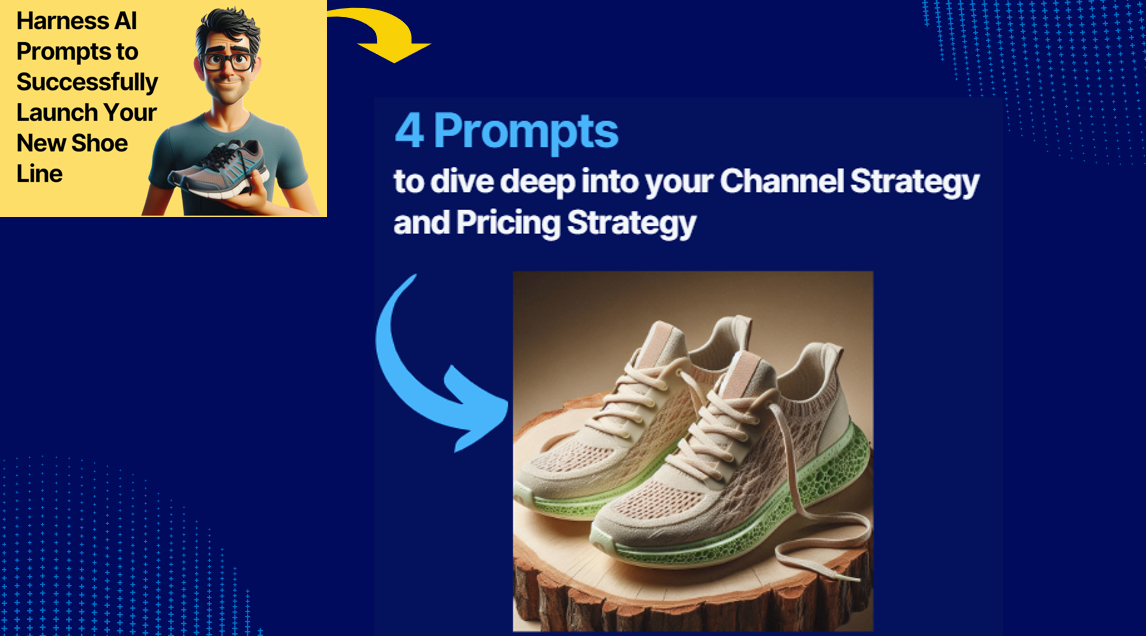
To demonstrate this, we will consider these 4 models using a hypothetical launch of a new line of sustainable running shoes.
Distribution Channel Strategy
The Distribution Channel Strategy framework helps you select and manage the most effective channels for reaching your customers.
Framework Overview:
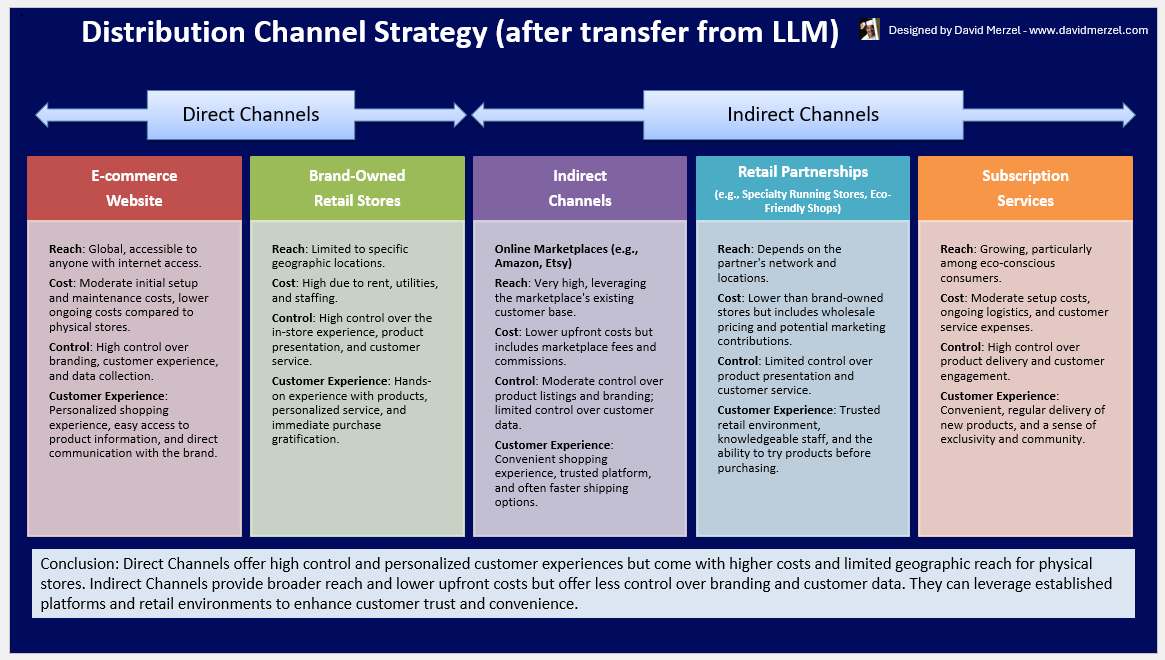
This approach helps us understand and optimize both direct and indirect channels, evaluating each based on reach, cost, control, and customer experience.
AI-Enhanced Approach:
To create a comprehensive Distribution Channel Strategy for sustainable running shoes, we can use the following prompt with an AI language model:
“Develop a Distribution Channel Strategy for a sustainable running shoes brand. Include both direct and indirect channels. For each channel, evaluate its reach, cost, control, and customer experience aspects. Focus on maximizing efficiency and customer satisfaction.”
Template:
- Direct Channels: Company-owned stores, E-commerce, Direct sales force
- Distribution Channel Strategy: Sustainable Running Shoes
- Indirect Channels: Wholesalers, Retailers, Value-Added Resellers
Source: Kotler, P., & Keller, K. L. (2016). Marketing Management. Pearson.
Below, you’ll find the results after executing the LLM with the specified prompt.
Multichannel Marketing Framework
The Multichannel Marketing Framework integrates various channels to provide a seamless customer experience.
Framework Overview:
This approach helps us inventory our online and offline channels and develop strategies for integrating them effectively.
AI-Enhanced Approach:
To develop a Multichannel Marketing Framework for sustainable running shoes, we can use the following prompt:
“Create a Multichannel Marketing Framework for a sustainable running shoes brand. Include both online and offline channels and describe how these channels can be integrated to provide a seamless customer experience. Focus on data sharing, consistent messaging, and cross-channel customer journey.”
Template:
Multichannel Marketing Framework: Sustainable Running Shoes
- Channel Inventory
- Online: Website, Mobile App, Social Media
- Offline: Stores, Events, Direct Mail
- Channel Integration:
Source: Neslin, S. A., & Shankar, V. (2009). Key Issues in Multichannel Customer Management. Journal of Interactive Marketing.
The outcome of running the LLM with the above prompt is provided below.

Price Elasticity of Demand
The Price Elasticity of Demand framework measures how demand changes as price changes.
Framework Overview:
This approach helps us understand the sensitivity of demand to price changes, which is crucial for pricing decisions.
AI-Enhanced Approach:
To analyze the Price Elasticity of Demand for sustainable running shoes, we can use the following prompt:
“Calculate and interpret the price elasticity of demand for a sustainable running shoes brand. Provide an example calculation and explain what the result means for pricing strategy. Include scenarios for elastic, inelastic, and unit elastic demand.”
Template:
- Price Elasticity of Demand: Sustainable Running Shoes
- Formula: Price Elasticity = % Change in Quantity Demanded / % Change in Price
- Example Calculation:
- Interpretation:
- Elastic Demand (|E| > 1): [LLM output]
- Inelastic Demand (|E| < 1): [LLM output]
- Unit Elastic (|E| = 1): [LLM output]
- Implications for Pricing Strategy:
Source: Marshall, A. (1890). Principles of Economics. Macmillan and Co.
You can see the results below, generated by the LLM using the mentioned prompt.

Value-Based Pricing
The Value-Based Pricing framework sets prices primarily based on the perceived value to the customer.
Framework Overview:
This approach helps us align our pricing with the value our customers perceive in our product, potentially allowing for higher margins.
AI-Enhanced Approach:
To develop a Value-Based Pricing strategy for sustainable running shoes, we can use the following prompt:
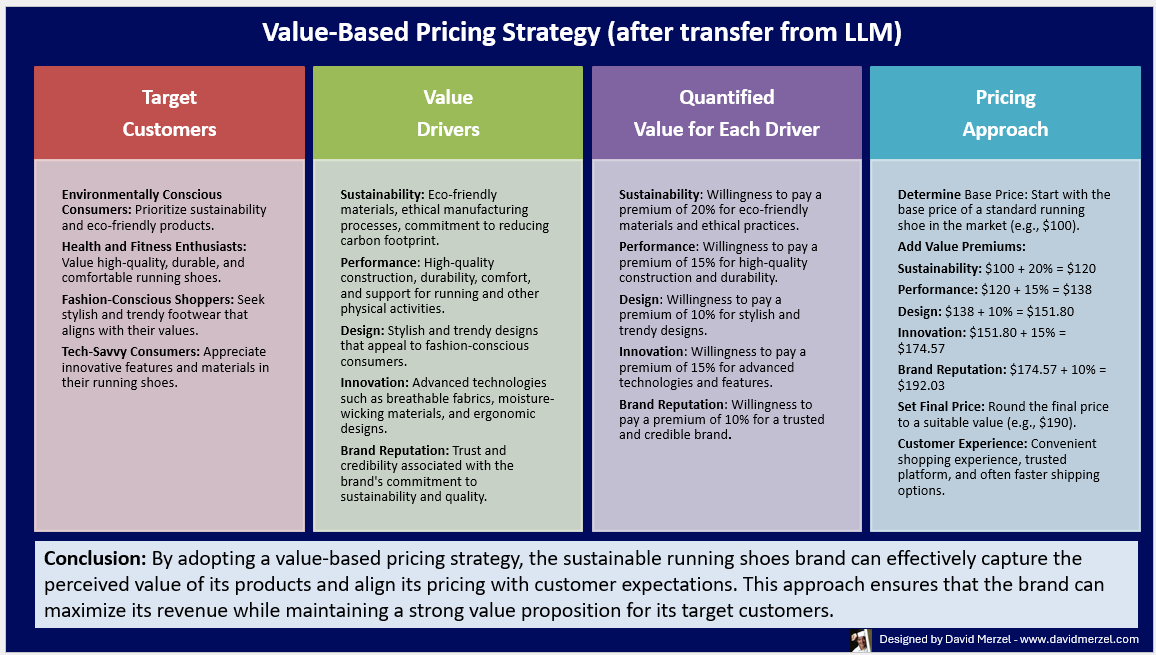
“Develop a value-based pricing strategy for a sustainable running shoes brand. Identify target customers, determine value drivers, quantify the value for each driver, and suggest a pricing approach. Include considerations for consumer surplus and competitive positioning.”
Template:
Value-Based Pricing: Sustainable Running Shoes
- Target Customers
- Value Drivers
- Quantified Value for Each Driver
- Total Value
- Suggested Price (allowing for consumer surplus)
- Pricing Approach Rationale:
Source: Nagle, T. T., & Müller, G. (2018). The Strategy and Tactics of Pricing: A Guide to Growing More Profitably. Routledge.
Presented below are the results obtained after running the LLM with the given prompt.
Blue Belt GTM AI Agent
As we advance to the Blue Belt level, we can envision a more sophisticated AI agent that can assist with these advanced distribution and pricing frameworks. This Blue Belt GTM AI Agent would be designed to handle more complex analyses and provide deeper insights into channel optimization and pricing strategies.
Capabilities of the Blue Belt GTM AI Agent:
- Channel Performance Analysis: The agent could analyze data from various distribution channels to evaluate their performance based on reach, cost, control, and customer experience metrics.
- Multichannel Integration Optimization: It could suggest ways to improve data sharing, messaging consistency, and cross-channel customer journeys based on real-time data analysis.
- Price Elasticity Modeling: The agent could continuously monitor sales data to calculate and update price elasticity models, providing real-time insights for pricing decisions.
- Value-Based Pricing Optimization: It could analyze customer feedback, market trends, and competitive data to refine value drivers and suggest optimal pricing strategies.
- Predictive Channel Forecasting: Using historical data and machine learning algorithms, the agent could predict future performance of different distribution channels.
- Dynamic Pricing Engine: The agent could implement real-time pricing adjustments based on demand fluctuations, competitor actions, and other market factors.
- Channel Conflict Resolution: It could identify potential conflicts between different distribution channels and suggest mitigation strategies.
By leveraging such an AI agent, we can enhance our ability to apply these advanced frameworks effectively, leading to more robust and insightful distribution and pricing strategies. The AI agent can help us gain deeper insights into channel performance, optimize our multichannel approach, and develop more sophisticated pricing models.
As we continue our journey through the belts, we’ll see how these advanced frameworks and AI capabilities can be applied to create even more sophisticated and effective GTM strategies. In the next chapter, we’ll explore how to integrate these distribution and pricing insights with broader business strategies, ensuring that our GTM efforts are aligned with overall business objectives and driving sustainable growth.
Remember, as we’ve learned from our karate journey, the path to mastery is ongoing. Each belt represents not just new knowledge, but a deeper understanding of how to apply that knowledge effectively. As we progress to the Blue Belt level, we’re not just learning new frameworks, but developing a more nuanced and integrated approach to GTM strategy. The AI agents we’re introducing are not meant to replace human creativity and intuition, but to augment and enhance our capabilities, allowing us to focus on higher-level strategic thinking and decision-making.
In the spirit of continuous improvement that we discussed in the White Belt chapter, I encourage you to approach these frameworks and AI tools with both curiosity and critical thinking. Experiment with them, adapt them to your specific context, and always be open to learning and refining your approach. The journey to GTM mastery is ongoing, and each new tool and framework we master brings us one step closer to achieving our Ikigai – our reason for being – in the business world.
Hands-On Exercise: SmartGuard Home Security System GTM Strategy
To help you apply the concepts we’ve covered in this chapter, let’s engage in a practical exercise. This hands-on activity will allow you to put your newfound knowledge into action and develop a comprehensive distribution and pricing strategy.
Scenario:
You are the product manager for “SmartGuard,” a new brand launching an innovative AI-powered home security system. This system includes smart cameras, door sensors, and a central hub that uses machine learning to detect unusual activities and alert homeowners. Your task is to develop a comprehensive distribution and pricing strategy using the four frameworks we’ve discussed in the Blue Belt chapter.
Exercise Steps:
- Distribution Channel Strategy:
Create a distribution channel strategy for SmartGuard, including both direct and indirect channels. For each channel, evaluate its reach, cost, control, and customer experience aspects. - Multichannel Marketing Framework:
Develop a multichannel marketing framework for SmartGuard. Include both online and offline channels, and describe how these channels can be integrated to provide a seamless customer experience. - Price Elasticity of Demand:
Calculate and interpret the price elasticity of demand for SmartGuard. Provide an example calculation and explain what the result means for pricing strategy. - Value-Based Pricing:
Develop a value-based pricing strategy for SmartGuard. Identify target customers, determine value drivers, quantify the value for each driver, and suggest a pricing approach. - Integration:
Explain how you would integrate insights from the price elasticity analysis into your distribution channel strategy and multichannel marketing framework. Provide at least two specific examples. - AI Enhancement:
Propose one way that AI could be used to enhance or automate part of your strategy for each of the four models.
Deliverables:
- A table outlining your distribution channel strategy
- A visual representation of your multichannel marketing framework
- A price elasticity calculation and interpretation
- A value-based pricing strategy outline
- A short paragraph on integration (200 words max)
- A list of AI enhancement ideas
Suggested Time Allocation:
- Distribution Channel Strategy: 30 minutes
- Multichannel Marketing Framework: 25 minutes
- Price Elasticity of Demand: 20 minutes
- Value-Based Pricing: 25 minutes
- Integration: 10 minutes
- AI Enhancement: 10 minutes
Total Time: 2 hours
This exercise allows you to apply all four models from the Blue Belt chapter in a cohesive, practical scenario. It encourages strategic thinking, analytical skills, and the integration of multiple frameworks. The AI enhancement component also ties back to the book’s overall theme of leveraging technology in GTM strategies.
Remember, the goal of this exercise is not just to complete each step, but to think critically about how these frameworks interact and complement each other. As you work through the exercise, consider how each decision you make in one framework might impact the others. This holistic thinking is key to developing a robust and effective distribution and pricing strategy.
As we continue our journey through the belts, we’ll see how these advanced frameworks and AI capabilities can be applied to create even more sophisticated and effective GTM strategies. In the next chapter, we’ll explore how to integrate these distribution and pricing insights with broader business strategies, ensuring that our GTM efforts are aligned with overall business objectives and driving sustainable growth.
In the spirit of continuous improvement that we discussed in the White Belt chapter, I encourage you to approach these frameworks and AI tools with both curiosity and critical thinking. Experiment with them, adapt them to your specific context, and always be open to learning and refining your approach. The journey to GTM mastery is ongoing, and each new tool and framework we master brings us one step closer to achieving our Ikigai – our reason for being – in the business world.
Good luck and enjoy the process of bringing SmartGuard to market!
Citations:
[1] https://ppl-ai-file-upload.s3.amazonaws.com/web/direct-files/23985622/3edf978c-f092-49a1-8955-30814eb362f1/book.docx
[2] https://ppl-ai-file-upload.s3.amazonaws.com/web/direct-files/23985622/b8f22697-6df4-4704-83f0-79d793f15ac2/book.docx
[3] https://ppl-ai-file-upload.s3.amazonaws.com/web/direct-files/23985622/38806b67-8d79-49a2-99f8-5330a1b7a762/book.docx
[4] https://ppl-ai-file-upload.s3.amazonaws.com/web/direct-files/23985622/9a39288c-b250-4e7b-8321-9e4101a6071c/book.docx
[5] https://whitecupsolutions.com/blog/the-importance-of-a-pricing-strategy-for-distributors/
[6] https://hospitalityinsights.ehl.edu/what-distribution-strategy
[7] https://repstack.co/maximizing-impact-through-integrated-multi-channel-marketing-approaches/
[8] https://sawtoothsoftware.com/resources/blog/posts/pricing-elasticity-of-demand
[9] https://www.netsuite.com/portal/resource/articles/business-strategy/value-based-pricing.shtml
[10] https://www.profitoptics.com/blog/use-cases-for-ai-in-distribution-demystifying-ai-for-distributors
[11] https://kojo.blog/agent-driven-commerce/
[12] https://www.linkedin.com/pulse/ai-tools-dynamic-pricing-adrianne-phillips-v5qqc
[13] https://automation.agency/how-ai-agents-are-revolutionizing-multi-channel-marketing/
[14] https://www.stratechi.com/distribution-strategy/
[15] https://www.dckap.com/blog/ai-in-distribution/
[16] https://gocargonet.com/ai-agents-logistics-supply-chain-management/
Engaging with You

As part of this journey, I also want to engage with you, my readers, by sharing portions of the book. Your feedback, comments, and suggestions will be invaluable in shaping the final product. I believe in the power of co-creation and would love to incorporate any specific concepts or ideas you might have. Of course, I will give full credit to any contributions that make it into the book. I will make sure nothing confidential will be published in the book.
Join the Conversation
If you have any suggestions or would like to discuss specific concepts, feel free to connect with me on LinkedIn thru personal messaging. I’m always happy to have a conversation and explore new ideas. Together, we can create something truly special. For collaboration or project discussions, you can also schedule a conversation in my calendar below or connect with me via email at david.merzel@hotmail.com. I look forward to further discussions!

 Md Consulting
Leave a comment