
As previously mentioned, I am excited to share excerpts from my upcoming book. As already shared with you, I’m in the process of writing a book that deep-dives into the world of go-to-market (GTM) strategy, blending it with personal experiences and passions that have shaped my career. I will also explore how AI is impacting all of us in sales, marketing, sales enablement, operation, and finance, from insights to planning, pitching and execution. This book will give you a new and fresh perspective on building strong GTM plans, leveraging a consumer and partner-centric approach, and asking the right questions to create real differentiation and impactful storytelling. You will find below a new excerpt focusing on the structure and what you can expect. Feel free to share your thoughts on this and open a conversation with me for collaboration. My calendar shared below is fully opened for this purpose.
Please find the excerpt below.
As we progress to the Brown Belt level, we delve deeper into frameworks that enhance strategy and performance optimization. Building upon the foundations developed in previous levels, these advanced frameworks provide a more nuanced and comprehensive approach to aligning vision with action, setting ambitious goals, optimizing the customer journey, and continuously improving our GTM efforts.
In this section, we’ll explore four key frameworks:
- Balanced Scorecard
- OKRs (Objectives and Key Results)
- AARRR (Pirate Metrics) Funnel Analysis
- A/B Testing Framework
Each of these frameworks offers unique insights that can significantly improve our ability to optimize strategy, engage customers, and drive business growth. Moreover, we’ll discuss how AI can be leveraged to enhance the application of these frameworks.
Balanced Scorecard
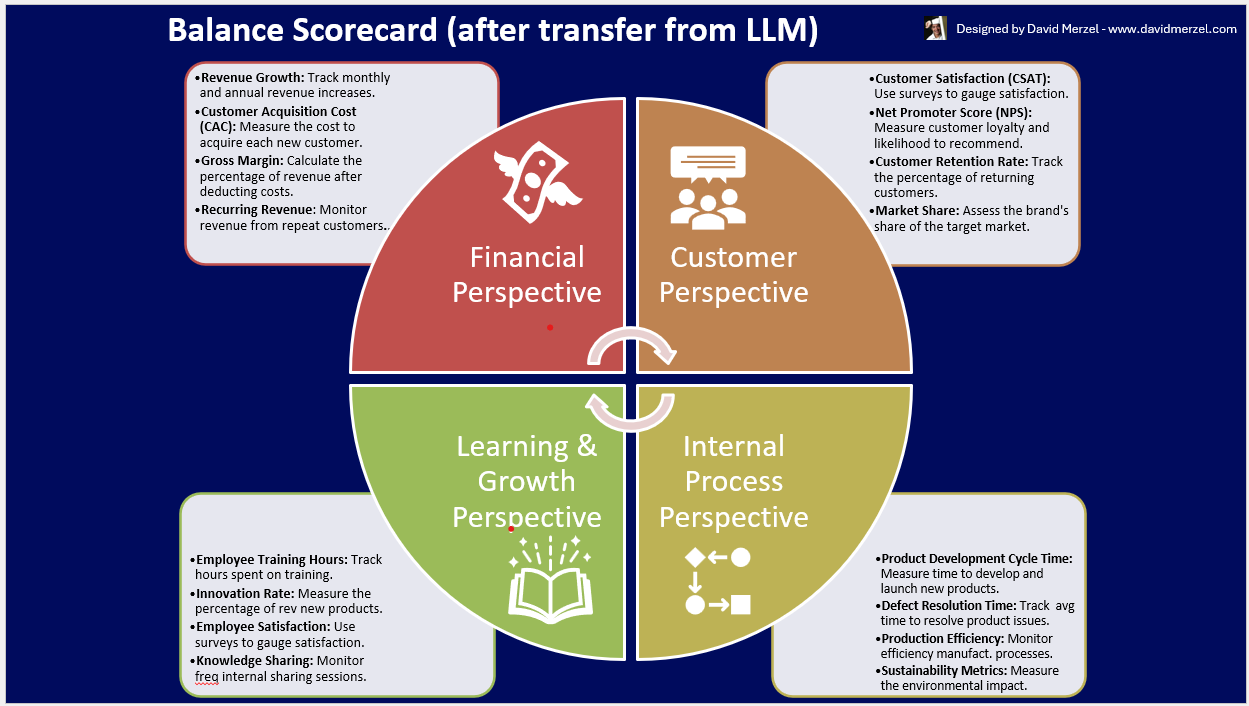
The Balanced Scorecard is a strategic planning and management system that helps organizations align business activities with their vision and strategy.
Framework Overview:
This framework considers four perspectives: Financial, Customer, Internal Business Processes, and Learning and Growth.
AI-Enhanced Approach:
To create a detailed Balanced Scorecard for sustainable running shoes, we can use the following prompt with an AI language model:
“Create a comprehensive Balanced Scorecard for a line of sustainable running shoes. Include specific metrics and initiatives for each perspective (Financial, Customer, Internal Business Processes, Learning and Growth) that align with the company’s sustainability goals and business objectives.”
Template:
Balanced Scorecard: Sustainable Running Shoes
OKRs (Objectives and Key Results)
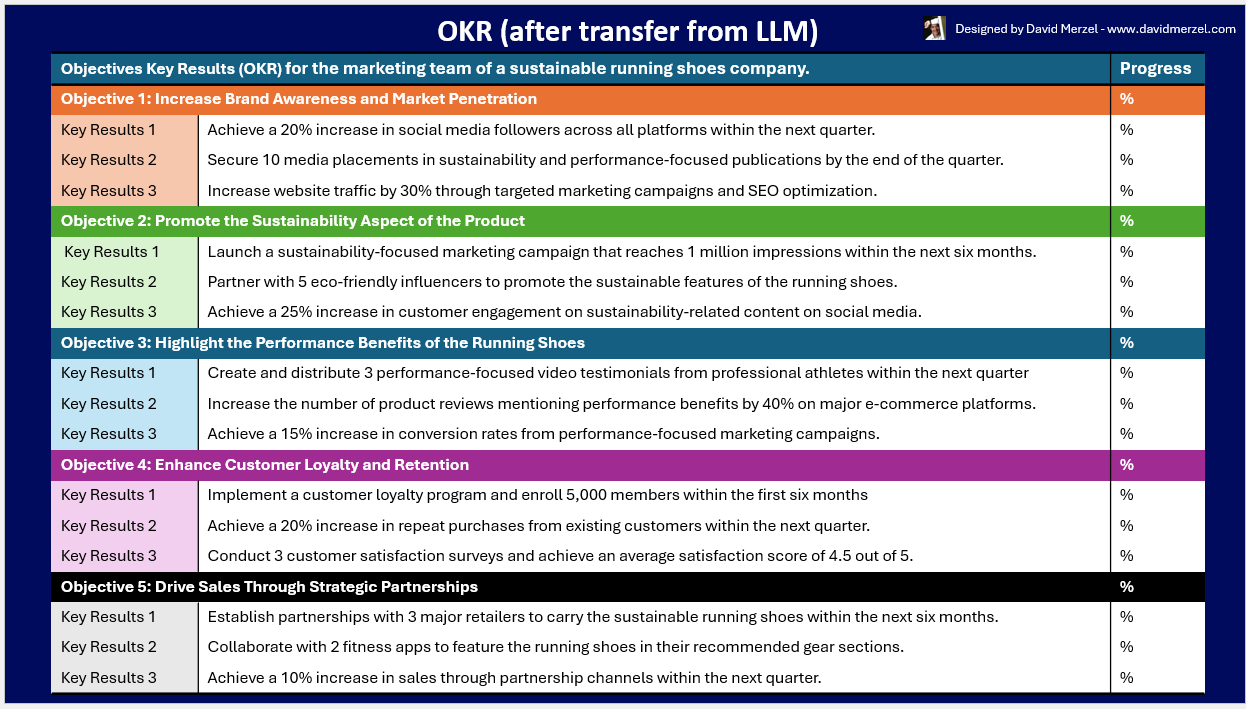
OKRs provide a framework for setting ambitious goals and tracking progress towards them.
Framework Overview:
This approach helps us set clear objectives and measurable key results to drive performance and alignment.
AI-Enhanced Approach:
To develop OKRs for sustainable running shoes, we can use the following prompt:
“Develop a set of OKRs for a sustainable running shoe company for the next quarter. Focus on objectives that drive sustainability, innovation, and market growth. Include 1-3 key results for each objective.”
Template:
OKRs: Sustainable Running Shoes
AARRR (Pirate Metrics) Funnel Analysis
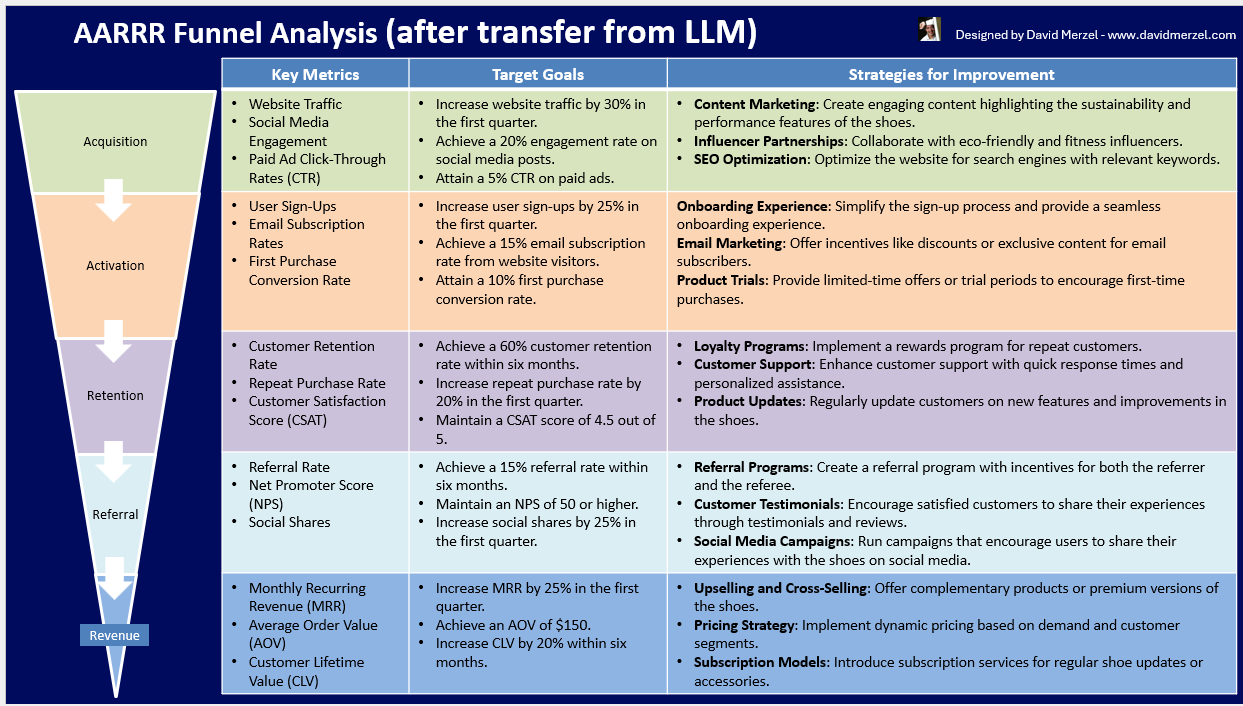
The AARRR Model focuses on key metrics for growth hacking and customer lifecycle management.
Framework Overview:
This model helps us track and optimize five key stages of the customer lifecycle: Acquisition, Activation, Retention, Referral, and Revenue.
AI-Enhanced Approach:
To develop a growth hacking strategy for sustainable running shoes using the AARRR model, we can use the following prompt:
“Develop a growth hacking strategy for a line of sustainable running shoes using the AARRR (Pirate Metrics) model. For each stage (Acquisition, Activation, Retention, Referral, Revenue), propose specific metrics to track and actionable tactics to improve performance. Focus on leveraging the eco-friendly aspects and performance features of the product.”
Template:
AARRR Model: Sustainable Running Shoes Growth Strategy
A/B Testing Framework
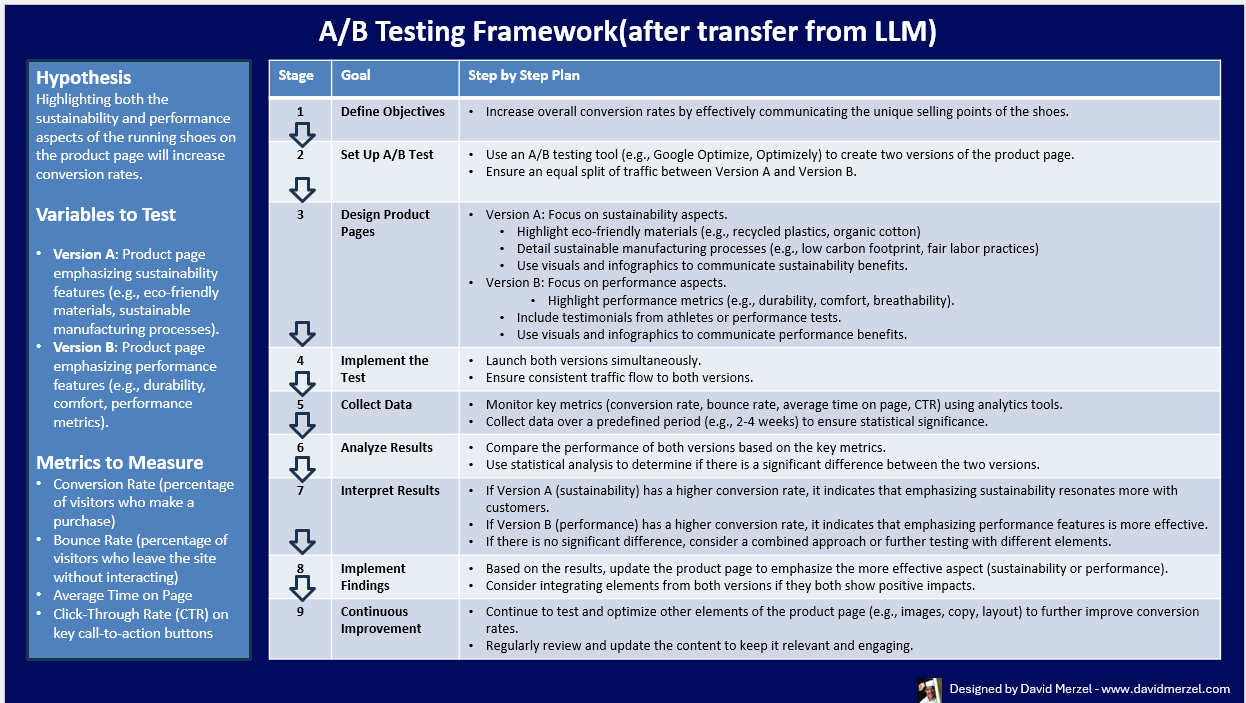
A/B testing allows for experimentation with various elements of GTM strategy to optimize results.
Framework Overview:
This approach helps us compare two versions of a variable to determine which performs better in achieving a given objective.
AI-Enhanced Approach:
To design an A/B testing plan for sustainable running shoes, we can use the following prompt:
“Design an A/B testing plan for a sustainable running shoe company’s e-commerce website. Include three test ideas, each with a hypothesis, variables to test, and success metrics. Focus on elements that highlight the shoes’ eco-friendly features and performance benefits.”
Template:
A/B Testing Plan: Sustainable Running Shoes
Brown Belt GTM AI Agent: StrategyMaster
As we advance to the Brown Belt level, we can envision a more sophisticated AI agent that can assist with these advanced strategy and performance optimization frameworks. This Brown Belt GTM AI Agent, StrategyMaster, would be designed to handle more complex analyses and provide deeper insights into strategy formulation and performance optimization.
Capabilities of StrategyMaster:
- Balanced Scorecard Integration: Analyze data across all perspectives, identify correlations, and suggest improvements.
- OKR Tracking and Prediction: Monitor progress on Key Results, predict likelihood of achieving Objectives, and suggest strategy adjustments.
- AARRR Funnel Optimization: Analyze customer behavior at each funnel stage, identify bottlenecks, and suggest personalized strategies.
- A/B Testing Automation: Design tests, analyze results in real-time, and suggest new elements to test based on patterns in customer behavior.
- Cross-Framework Synthesis: Integrate insights from all four frameworks to provide a holistic view of strategy and performance.
- Predictive Modeling: Use historical data and machine learning to forecast future performance and suggest proactive strategies.
- Real-time Strategy Adjustment: Continuously monitor KPIs and suggest real-time adjustments to strategies based on changing market conditions.
Hands-On Exercise: Integrated Strategy Optimization for Sustainable Running Shoes
To help you apply the concepts we’ve covered in this chapter, let’s engage in a practical exercise. This hands-on activity will allow you to put your newfound knowledge into action and develop a comprehensive strategy and performance optimization plan for a sustainable running shoe company.
Scenario: You are the Chief Strategy Officer for “EcoStride,” a growing sustainable running shoe company. Your task is to develop a comprehensive strategy and performance optimization plan using the four frameworks we’ve discussed in the Brown Belt chapter.
Exercise Steps:
- Balanced Scorecard: Create a Balanced Scorecard for EcoStride, including at least two objectives and metrics for each perspective.
- OKRs: Develop three company-wide OKRs for the next quarter, each with 2-3 key results.
- AARRR Funnel Analysis: Identify one key metric and one strategy for improvement for each stage of the AARRR model in the context of EcoStride.
- A/B Testing: Design two A/B tests to improve EcoStride’s e-commerce conversion rate, focusing on sustainability messaging.
- Integration: Explain how insights from your A/B tests could inform adjustments to your Balanced Scorecard or OKRs. Provide at least two specific examples.
- AI Enhancement: Propose one way that StrategyMaster could be used to enhance or automate part of your strategy for each of the four models.
Deliverables:
- A completed Balanced Scorecard
- A list of OKRs
- An AARRR funnel analysis table
- Two A/B test designs
- A short paragraph on integration (200 words max)
- A list of AI enhancement ideas
Suggested Time Allocation:
- Balanced Scorecard: 30 minutes
- OKRs: 20 minutes
- AARRR Funnel Analysis: 25 minutes
- A/B Testing: 20 minutes
- Integration: 15 minutes
- AI Enhancement: 10 minutes
Total Time: 2 hours
This exercise allows you to apply all four models from the Brown Belt chapter in a cohesive, practical scenario. It encourages strategic thinking, performance optimization, and the integration of multiple frameworks. The AI enhancement component also ties back to the book’s overall theme of leveraging technology in GTM strategies.
Remember, the goal of this exercise is not just to complete each step, but to think critically about how these frameworks interact and complement each other. As you work through the exercise, consider how each decision you make in one framework might impact the others. This holistic thinking is key to developing a robust and effective strategy and performance optimization plan.
Good luck, and enjoy the process of optimizing EcoStride’s strategy and performance!
Citations:
[1] https://ppl-ai-file-upload.s3.amazonaws.com/web/direct-files/23985622/9a39933c-6ab7-48dc-8e77-4a42cce2b1a3/paste.txt
[2] https://ppl-ai-file-upload.s3.amazonaws.com/web/direct-files/23985622/88bb3ea6-79cd-46f2-9ad3-6ba9654c0010/book.docx
[3] https://ppl-ai-file-upload.s3.amazonaws.com/web/direct-files/23985622/1a829935-d5ff-4d3c-b338-beb007a66b02/book.docx
Engaging with You

As part of this journey, I also want to engage with you, my readers, by sharing portions of the book. Your feedback, comments, and suggestions will be invaluable in shaping the final product. I believe in the power of co-creation and would love to incorporate any specific concepts or ideas you might have. Of course, I will give full credit to any contributions that make it into the book. I will make sure nothing confidential will be published in the book.
Join the Conversation
If you have any suggestions or would like to discuss specific concepts, feel free to connect with me on LinkedIn thru personal messaging. I’m always happy to have a conversation and explore new ideas. Together, we can create something truly special. For collaboration or project discussions, you can also schedule a conversation in my calendar below or connect with me via email at david.merzel@hotmail.com. I look forward to further discussions!

 Md Consulting
Leave a comment