
As an author and trainer specializing in AI with a focus on Go-to-Market strategies, I’m excited to share insights on a crucial distinction in the world of artificial intelligence: AI agents versus AI workflows and automation. This topic has become increasingly relevant in my work, as businesses seek to leverage AI technologies to enhance their operations and customer experiences.
Understanding AI Agents
AI agents represent a significant leap forward in artificial intelligence technology. Unlike traditional AI workflows and automation, AI agents possess a level of autonomy and decision-making capability that sets them apart. In my experience working with various organizations, I’ve seen firsthand how AI agents can transform business processes and customer interactions.
Key Differences
Autonomy
AI agents can operate independently, making decisions based on their programming and the data they receive. They can adapt to new situations and learn from their interactions. This adaptability is crucial in today’s fast-paced business environment, where conditions can change rapidly.
Goal-Oriented Behavior
These agents are designed with specific objectives in mind. They can formulate plans and take actions to achieve these goals, often without direct human intervention. This capability allows businesses to tackle complex challenges more efficiently.
Interaction with the Environment
AI agents can perceive their environment, process information, and respond accordingly. This ability to interact and adapt is crucial for tasks that require real-time decision-making. In my training sessions, I often emphasize how this feature can lead to more dynamic and responsive customer service solutions.
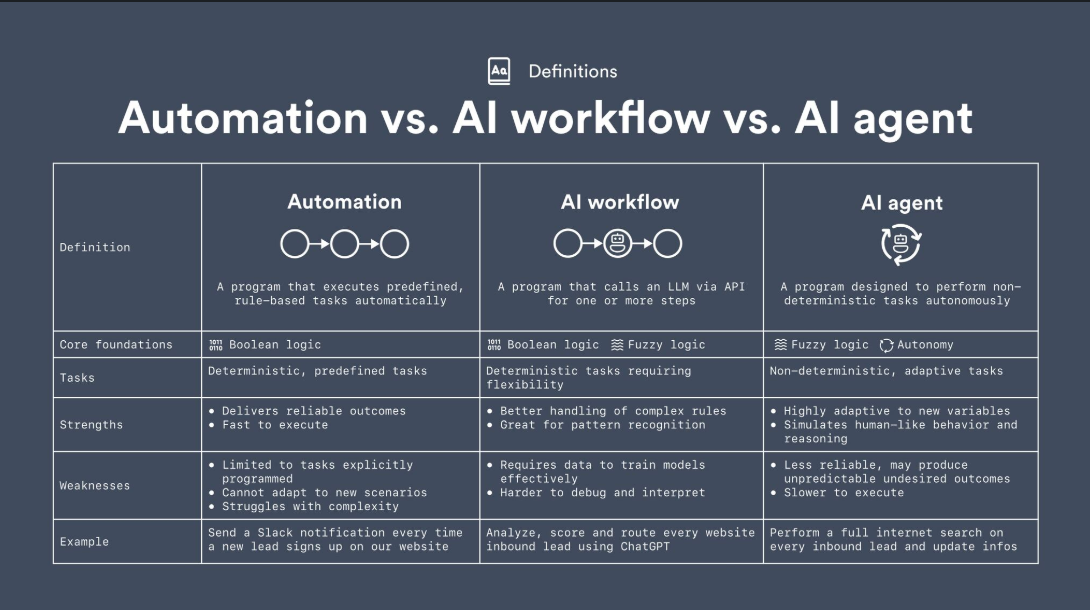
Credit: Illustration by Alexandre Kantjas, shared on LinkedIn here: Post | LinkedIn
AI Workflows and Automation
In contrast, AI workflows and automation are more structured and predefined:
- They follow set patterns and rules
- Typically require human oversight for changes or adaptations
- Excel at repetitive tasks but may struggle with unexpected scenarios
While working with clients, I’ve observed that these traditional automation approaches still have their place, particularly in industries with highly regulated processes or where consistency is paramount.
Implications for Business
Understanding this distinction is crucial for businesses looking to leverage AI effectively:
- AI agents can handle complex, dynamic tasks that require judgment
- Workflows and automation are ideal for consistent, repetitive processes
- Choosing the right approach depends on the specific needs of your business
In my consulting work, I often guide companies through the decision-making process of when to employ AI agents versus traditional automation. It’s not always a clear-cut choice, and sometimes a hybrid approach yields the best results.
The Future of AI in GTM Strategies
As we continue to explore the potential of AI in Go-to-Market strategies, the role of AI agents becomes increasingly significant. They offer the potential for more personalized customer interactions, dynamic market analysis, and adaptive sales approaches.
In my recent book on AI-driven GTM strategies, I delve into case studies where companies have successfully integrated AI agents into their marketing and sales processes. One particularly striking example involves a B2B software company that used AI agents to personalize their entire customer journey, from initial outreach to post-sale support, resulting in a 30% increase in customer retention.
Balancing AI and Human Expertise
While AI agents offer tremendous potential, it’s crucial to strike the right balance between AI capabilities and human creativity. In my training programs, I emphasize the importance of viewing AI as a tool to augment human skills rather than replace them entirely. This approach allows businesses to leverage the best of both worlds – the efficiency and scalability of AI, combined with the nuanced understanding and emotional intelligence of human experts.
Ethical Considerations
As we embrace these advanced AI technologies, we must also be mindful of the ethical implications. In my work, I stress the importance of responsible AI development and deployment. This includes ensuring data privacy, addressing potential biases in AI systems, and maintaining transparency in AI-driven decision-making processes.
Conclusion
By understanding and leveraging both AI agents and traditional AI workflows, businesses can create more robust and flexible GTM strategies that adapt to the ever-changing market landscape. As we move forward, the key to success will be in thoughtfully integrating these AI technologies into our business processes, always keeping in mind the unique value that human insight brings to the table.
In my ongoing research and training programs, I continue to explore new developments in this field, always with an eye towards practical applications that can drive real business value. The future of AI in business is bright, and I’m excited to be part of this transformative journey.
Identifying AI Agent Opportunities
To effectively integrate AI agents into your organization:
- Conduct a business workshop with your team to identify potential use cases.
- Assess areas where AI agents can add the most value to your GTM strategies.
- Consider both customer-facing and internal applications of AI agents.
AI Adoption Training Program
To support organizations in unlocking their AI potential, I’ve designed a comprehensive training program that mirrors the concepts in my book. This program covers:
- Prompt engineering
- AI agent development
- Practical implementation of AI tools in GTM strategies
The training provides hands-on experience with real-world AI applications across various industries, equipping your team with the skills needed to leverage AI effectively.


Next Steps
If you’re interested in exploring how AI agents can benefit your sales, operations, or marketing teams, I’m offering free consultation calls. During these sessions, we can discuss your specific needs and align on AI development and adoption strategies tailored to your organization, whether you’re part of a large enterprise, mid-sized company, or small business.
AI agents represent a significant leap forward in business technology. By understanding their potential and implementing them responsibly, organizations can gain a competitive edge in the rapidly evolving digital landscape. Start your AI agent journey today and position your business at the forefront of innovation.
Engaging with You

As part of this journey, I also want to engage with you, my readers, by sharing portions of the book. Your feedback, comments, and suggestions will be invaluable in shaping the final product. I believe in the power of co-creation and would love to incorporate any specific concepts or ideas you might have. Of course, I will give full credit to any contributions that make it into the book. I will make sure nothing confidential will be published in the book.
Join the Conversation
If you have any suggestions or would like to discuss this training or any other specific concepts, feel free to connect with me on LinkedIn thru personal messaging. I’m always happy to have a conversation and explore new ideas. Together, we can create something truly special. For collaboration or project discussions, you can also schedule a conversation in my calendar below or connect with me via email at david.merzel@hotmail.com. I look forward to further discussions! I am also happy to meet you in person during CES at Las Vegas on 8 or 9 January if you attend.
Citations:
[1] https://www.ciklum.com/resources/blog/ai-agents-explained
[2] https://www.enkryptai.com/blog/ai-automation-vs-ai-agents
[3] https://www.ibm.com/think/topics/ai-agents-vs-ai-assistants
[4] https://www.ada.cx/blog/chatbot-vs-ai-agent-what-s-the-difference-and-why-does-it-matter/
[5] https://www.linkedin.com/pulse/ai-agents-vs-agentic-workflows-sanjay-kumar-mba-ms-phd-fl0kc
[6] https://www.linkedin.com/pulse/ai-agents-vs-automation-workflows-justin-rush–zkg2c

 Md Consulting
Leave a comment