
Here’s a revised version of the blog post as a new chapter for your book:
As previously mentioned, I am excited to share excerpts from my upcoming book. I’m writing a book that deep-dives into the world of go-to-market (GTM) strategy. It blends personal experiences and passions that have shaped my career. I will also explore how AI is impacting all of us in sales, marketing, and sales enablement. AI influences operation and finance, from insights to planning. It affects pitching and execution. This book will give you a new and fresh perspective on building strong GTM plans. It leverages a consumer and partner-centric approach. It also asks the right questions to create real differentiation and impactful storytelling. You will find below a new excerpt focusing on the structure and what you can expect. Feel free to share your thoughts on this and open a conversation with me for collaboration. My calendar shared below is fully opened for this purpose.
Please find the excerpt below.
We stand at the cusp of a new era in business. The AI revolution is reshaping how we approach Go-To-Market (GTM) strategies. This chapter explores the global trends in AI adoption and their implications for businesses of all sizes.
The Rising Tide of AI Optimism
Recent global studies have shown a significant increase in AI optimism. In 2023, 76% of people believed AI would have a positive impact on their lives, up from 70% in 2022. This surge in optimism reflects the excitement I feel. I am authoring this book on GTM strategies in the AI era.
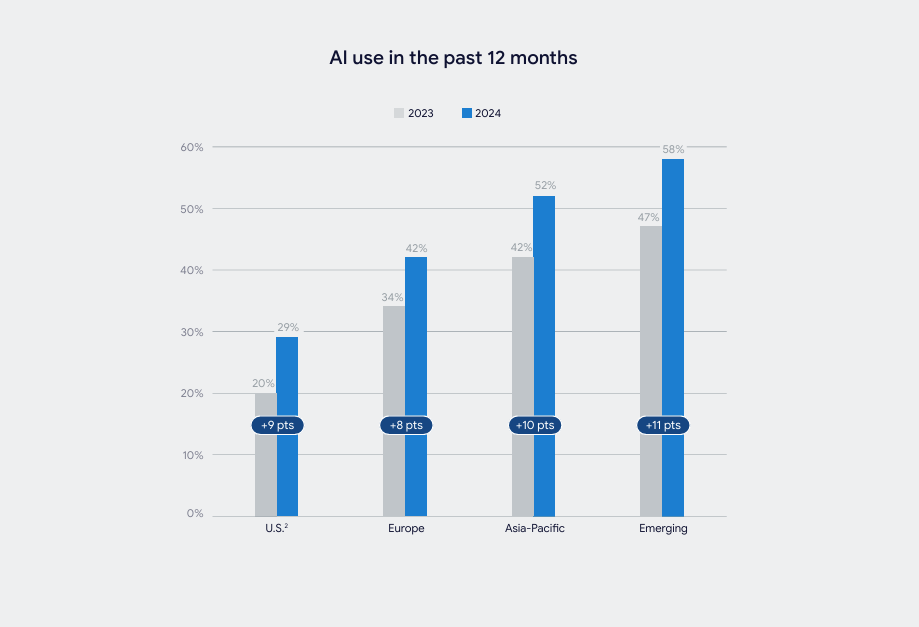
Recent global studies have shown a significant increase in AI optimism and adoption. According to Google and Ipsos’ ‘Our Life with AI’ report, 48% of the global public used generative AI. This usage occurred in the past year. The highest usage was in emerging markets and the Asia-Pacific region.
All the coming graphs in this study are coming from this IPSOS survey and you can find it here: ipsos_google_our-life-with-ai_2024_25.pdf.
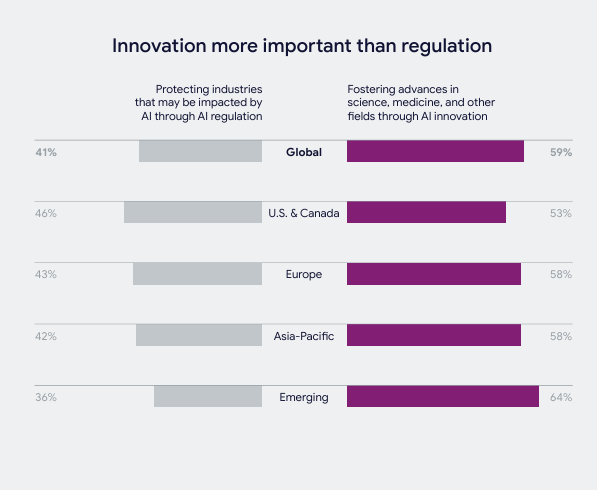
Since last year, optimism about AI’s impact on the economy and workforce has increased. More people now believe AI will change the economy in a positive way (from 42% to 49%). Additionally, more people believe AI will change jobs and industries in the next five years.
Now, they think this change will be beneficial (from 52% to 58%). Workforce disruption due to AI is anticipated to be lower. Among the 53% of the public who believe they will be impacted by AI, 44% expect to be more productive. They expect to get more done. Meanwhile, 16% expect they will have to find a new role because of AI, down from 19% in 2023.
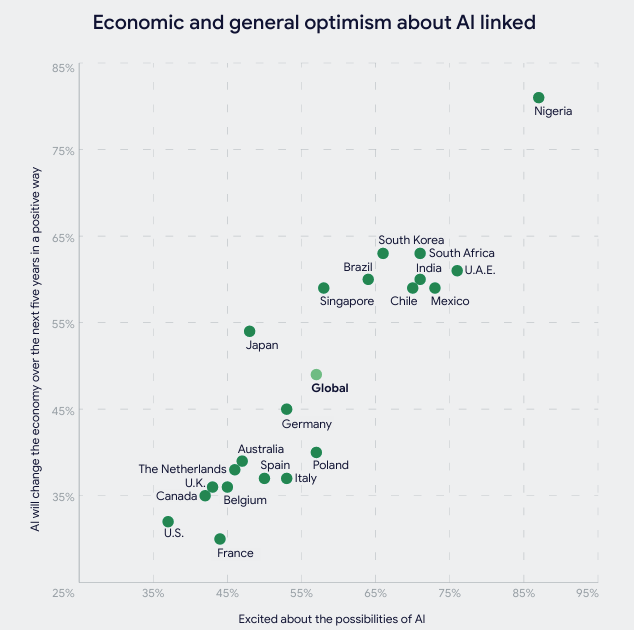
There is a global rise in excitement about AI. Positive perceptions of AI’s economic impact are increasing. Countries with more excitement about AI’s potential expect the most positive economic gains from the technology. Countries in the Global South, such as Nigeria, Mexico, and South Africa, are the most excited about AI. They believe most strongly that AI will change the economy positively.
AI’s Impact on Business: A Personal Perspective
Let me share a story that illustrates this transformation. I recently consulted with Sarah, a small business owner who was initially skeptical about AI. After implementing AI-powered customer service chatbots, Sarah saw a 30% increase in customer satisfaction and a 20% boost in sales. Her story is just one example. It demonstrates how AI can be a game-changer. This happens when AI is applied thoughtfully to GTM strategies. This trend isn’t isolated. The IPSOS report indicates that 57% of people globally are excited about AI’s potential, outweighing concerns (43%). Excitement is particularly high in emerging markets.
AI as a Problem-Solver
Global studies indicate that 63% of people believe AI will help solve complex problems facing society. This aligns perfectly with the AI training modules we’re developing at MD Consulting. We’re not just teaching technical skills. We are empowering people to think creatively about how AI can address real-world challenges in their GTM approaches.
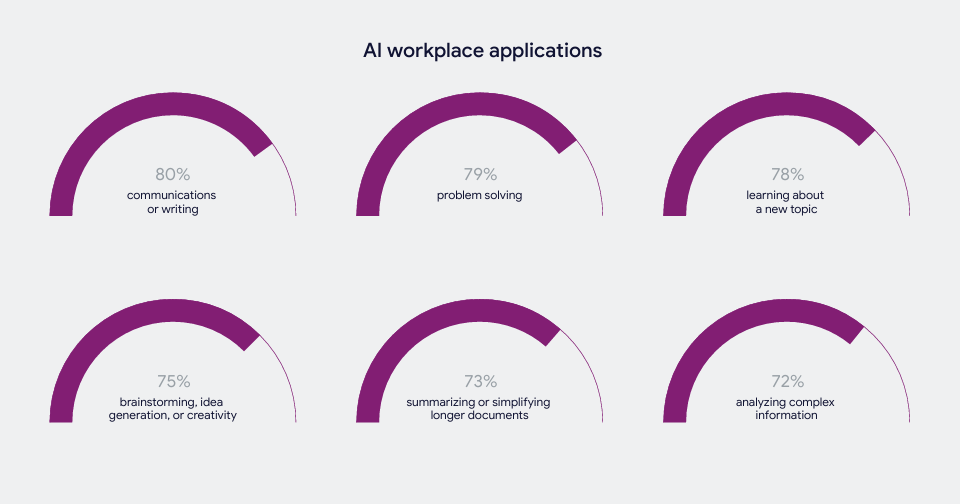
Three quarters (74%) of AI users say they use AI for work. This group tends to skew slightly younger. It is also more affluent overall. Specifically, 46% of workplace AI users are under 35. Additionally, 60% are higher income. Despite these skews, AI isn’t just being used by desk workers and Gen Z. Work users include blue-collar workers (67% of blue-collar AI users use AI for work) and white-collar workers (77%). They also include older (68% aged 50-74) and younger workers. Notably, just 41% of workplace AI users are female. This suggests that the gender gap in AI usage is even more pronounced in the workforce. Among all AI users, 45% are female and 55% are male.
Workplace and work-related use is varied and goes far beyond drafting emails or cover letters. People use generative AI to assist with writing (80% of workplace users), problem solving (79%), and brainstorming (75%), as well as using AI to help digest longer documents (73%) or complex information (72%)
The Learning Revolution
One of the most exciting trends is the growing interest in using AI for learning and education. As someone passionate about knowledge sharing, I’ve incorporated this insight into my consulting practice. We’re developing AI agents that can provide 24/7 support for continuous learning within organizations, enhancing GTM strategy development and execution.
The growing interest in AI for learning and education aligns with global trends. The survey reveals that people are excited about AI’s use in finding information, personal assistants, and tutoring.
Addressing Concerns
As we embrace AI in our GTM strategies, we must address concerns about its impact on jobs. We also need to consider privacy issues. These are crucial issues that require careful consideration. It’s about finding the right balance. We need to harness AI’s power. At the same time, we must ensure it enhances human capabilities rather than replacing them in marketing and sales roles.
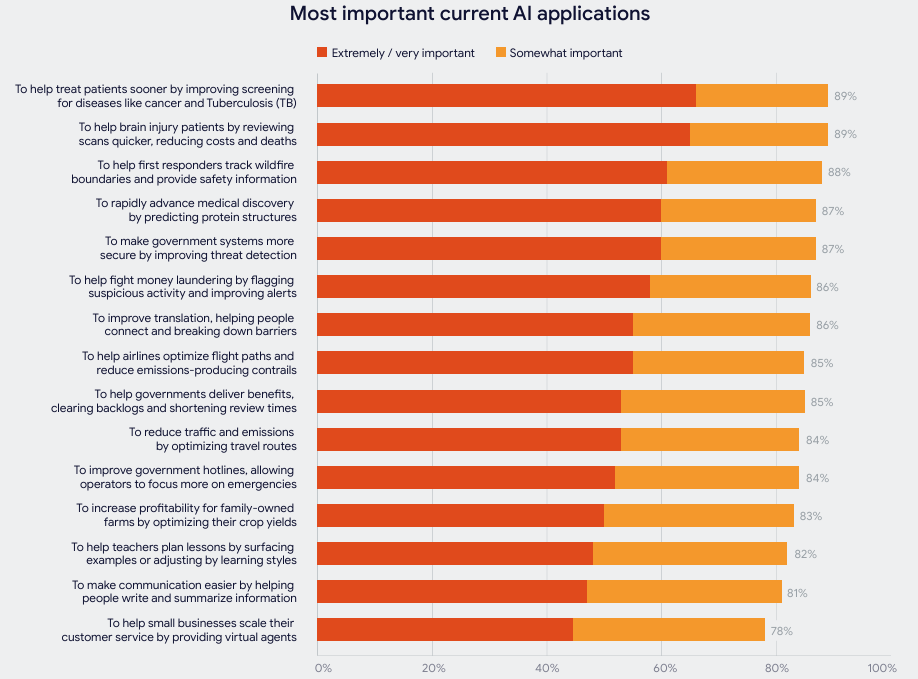
While concerns exist, the report shows increasing optimism about AI’s impact on the economy and workforce. Many believe AI will help them be more productive at work. 72% expect a positive impact on science. 71% foresee benefits in medicine. You will find below a graph depicting the expected positive impacts of AI on various sectors.
The Future of AI-Powered GTM Strategies
As we look to the future, the possibilities for AI in GTM strategies are endless. You could be a small business owner like Sarah. You might work as a marketing executive at a large corporation. AI has the power to transform our approach to market analysis. It can also revolutionize customer engagement and sales processes.
In the following chapters, we’ll explore practical applications of AI in various aspects of GTM strategy. These aspects range from market intelligence to customer acquisition and retention. We’ll see how AI can drive consistency, productivity, and scalability in your GTM efforts. It’s important to stay true to the human elements that drive meaningful connections with customers.
The AI revolution in GTM strategies is here, and it’s deeply human at its core. Are you ready to be part of it?
Citations:
[1] https://ppl-ai-file-upload.s3.amazonaws.com/web/direct-files/23985622/5e57deae-665d-4d81-a593-32dd8e555f6d/book.docx
Engaging with You

As part of this journey, I also want to engage with you, my readers, by sharing portions of the book. Your feedback, comments, and suggestions will be invaluable in shaping the final product. I believe in the power of co-creation and would love to incorporate any specific concepts or ideas you might have. Of course, I will give full credit to any contributions that make it into the book. I will make sure nothing confidential will be published in the book.
Join the Conversation
If you have any suggestions, feel free to connect with me on LinkedIn. If you would like to discuss specific concepts, reach out thru personal messaging. I’m always happy to have a conversation and explore new ideas. Together, we can create something truly special. For collaboration or project discussions, you can schedule a conversation in my calendar below. You can also connect with me via email at david.merzel@hotmail.com. I look forward to further discussions!

 Md Consulting
Leave a comment