
As we move deeper into the AI landscape, the challenge isn’t just about adopting AI—it’s about adopting the right AI. The marketplace is flooded with tools, each boasting unique capabilities. From ChatGPT’s prowess in reasoning and writing to Gemini’s coding expertise and Perplexity’s dominance in web search and deep research, the options are vast. But how do you decide which tool aligns with your business needs?
This chapter builds on the foundational principles from earlier chapters, particularly the Yellow Belt focus on prioritization and the Orange Belt emphasis on alignment. Here, we’ll explore how to decode AI capabilities and align them with your organization’s goals, ensuring that your investment in AI drives measurable value.
The Complexity of Choice
The chart above provides a clear comparison of some of the most popular AI tools available today. Each tool excels in specific areas:
- ChatGPT: Everyday answers, writing, reasoning, and math.
- Claude: Strong in reasoning and writing but lacks depth in research.
- Grok: A balanced performer across multiple areas.
- Gemini: Exceptional at coding and video generation.
- Perplexity: Dominates deep research and web search capabilities.
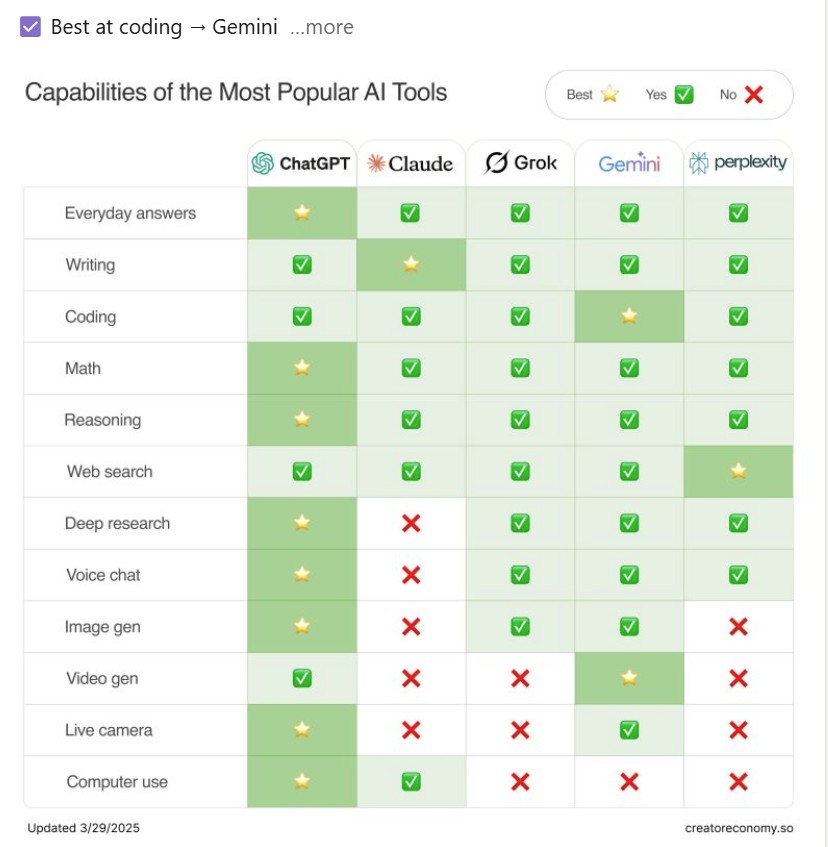
While this chart is helpful, it’s only a starting point. The real challenge lies in understanding how these capabilities map to your business objectives.
Guiding Steps
Follows the steps using the belts to make easier and structured the process.
⚪ Step 1: Define Your Business Needs
As we discussed in the White Belt chapter, every successful strategy begins with clarity of purpose. Before diving into features, ask yourself:
1️⃣ What specific problems are we trying to solve?
2️⃣ Which processes need to be faster, more consistent, or more scalable?
3️⃣ How will AI integrate into our existing workflows?
For example, if your organization struggles with customer inquiries, a tool strong in reasoning and everyday answers (like ChatGPT) might be ideal. If your focus is on improving coding efficiency or automating software development tasks, Gemini could be a better fit.
🟡 Step 2: Prioritize High-Impact Use Cases
Building on the Yellow Belt principle of prioritization, it’s crucial to focus on high-impact use cases when selecting an AI tool. Use this framework to evaluate potential matches:
1️⃣ Identify your top three business challenges.
2️⃣ Map those challenges to the capabilities listed in the chart above.
3️⃣ Prioritize tools that address multiple challenges effectively.
For example:
- If you need help with content creation and customer support automation, ChatGPT might be a strong contender.
- If your focus is on coding automation or video generation for marketing campaigns, Gemini could be a better fit.
🟠 Step 3: Assess Your Team’s Readiness
AI adoption isn’t just about technology—it’s about people. As we explored in the Orange Belt chapter on organizational alignment, successful adoption requires assessing your team’s readiness to embrace new tools.
Ask yourself:
- Does your team have the skills to use these tools effectively?
- Are there knowledge gaps that need bridging through training?
- Is there resistance to change that must be addressed?
In my consulting practice at MD Consulting, I emphasize building AI literacy as a core part of any adoption strategy. Without it, even the most advanced tools can fail to deliver value.
🟢 Step 4: Start Small and Scale Smart
As we discussed in the Green Belt chapter on scalability, it’s essential to start small before scaling AI initiatives across your organization. Begin with pilot projects that align with critical business needs and have clear success metrics.
For instance:
- Test ChatGPT for automating customer service responses.
- Use Perplexity for deep research projects requiring comprehensive data analysis.
- Experiment with Gemini for coding tasks or video content creation.
These pilots will provide valuable insights into how well these tools integrate into your workflows and whether they deliver measurable value.
🔵 Step 5: Evaluate Long-Term Fit
Building on the Blue Belt chapter which teaches to look at Long Term perspective , it is key to evalute how the current tool selected fit into a long term fit. We discussed on the Blue Belt chapter how to have a long term perspective.
Here you want to evaluate
- Will this tool scale as our needs evolve?
- Does it integrate seamlessly with other technologies we use?
- Are there hidden costs (e.g., training, maintenance) that could impact ROI?
🟤 Step 6: Implement Governance and Ethical Guidelines
As we explored in the Brown Belt, it is key to embrace the ethical perspective in all the GTM deployment.
This is to ensure that you are complying and governing your AI efforts by a more robust structure of policies that are compliant with your values.
Here are come steps you can follow
- Create a guideline for usage and data use;
- Test to see for biases;
- Document the AI efforts.
⚫ Step 7: Continuous Learning and Adaptation
As we explored in the Black Belt, it is key to ensure a loop of learning that can continuously evolve thanks to ongoing assessment. What you did today can change tomorrow.
Leverage feedback to implement improvement
- Evaluate impact and results
- Be open to evolution and changes
Connecting Back to Your Journey
This chapter ties together lessons from earlier parts of this book:
- The White Belt chapter emphasized starting with clarity of purpose.
- The Yellow Belt chapter focused on prioritizing efforts for maximum impact.
- The Orange Belt chapter explored aligning technology with organizational goals.
- The Green Belt chapter highlighted scalability as a key factor for success.
- The Blue Belt highlighted the key of Long Term Perspective
- The Brown Belt has to show your GTM ethics
- The Black Belt has to implement continues learning
By combining these principles with a clear understanding of AI capabilities (as shown in the chart above), you can make informed decisions that drive real business value.
Your Next Step
Choosing the right AI tool isn’t just about comparing features—it’s about aligning technology with strategy, people, and processes. As you evaluate options like ChatGPT, Gemini, or Perplexity, remember that success lies not in having the most advanced tool but in having the right tool for your unique needs.
If you’re ready to take the next step but feel overwhelmed by choices, I invite you to reach out for a consultation through MD Consulting. Together, we can assess your needs, build a roadmap for adoption, and ensure that your AI journey is both strategic and impactful.
Because at the end of the day, adopting AI isn’t just about technology—it’s about transformation.
#AIStrategy #DigitalTransformation #AIAdoption #MDConsulting #Innovation
Engaging with You
As part of this journey, I also want to engage with you, my readers, by sharing portions of the book. Your feedback, comments, and suggestions will be invaluable in shaping the final product. I believe in the power of co-creation and would love to incorporate any specific concepts or ideas you have. Of course, I will give full credit to any contributions that make it into the book.
Join the Conversation
If you have any suggestions, feel free to connect with me on LinkedIn. If you would like to discuss specific concepts, reach out thru personal messaging. I’m always happy to have a conversation and explore new ideas. Together, we can create something truly special. For collaboration or project discussions, you can schedule a conversation in my calendar below. You can also connect with me via email at mdconsulting@davidmerzel.com. I look ahead to further discussions!
Answer from Perplexity: pplx.ai/share

 Md Consulting
Leave a comment