As previously mentioned, I am excited to share excerpts from my upcoming book. As already shared with you, I’m in the process of writing a book that deep-dives into the world of go-to-market (GTM) strategy, blending it with personal experiences and passions that have shaped my career. I will also explore how AI is impacting all of us in sales, marketing, sales enablement, operation, and finance, from insights to planning, pitching and execution. This book will give you a new and fresh perspective on building strong GTM plans, leveraging a consumer and partner-centric approach, and asking the right questions to create real differentiation and impactful storytelling. You will find below a new excerpt focusing on the structure and what you can expect. Feel free to share your thoughts on this and open a conversation with me for collaboration. My calendar shared below is fully opened for this purpose.
Please find the excerpt below.
In the ever-evolving landscape of business, market intelligence has become the cornerstone of successful Go-To-Market strategies. As we progress from our White Belt foundations, we now delve into the intricate world of market understanding, where data transforms into actionable insights.
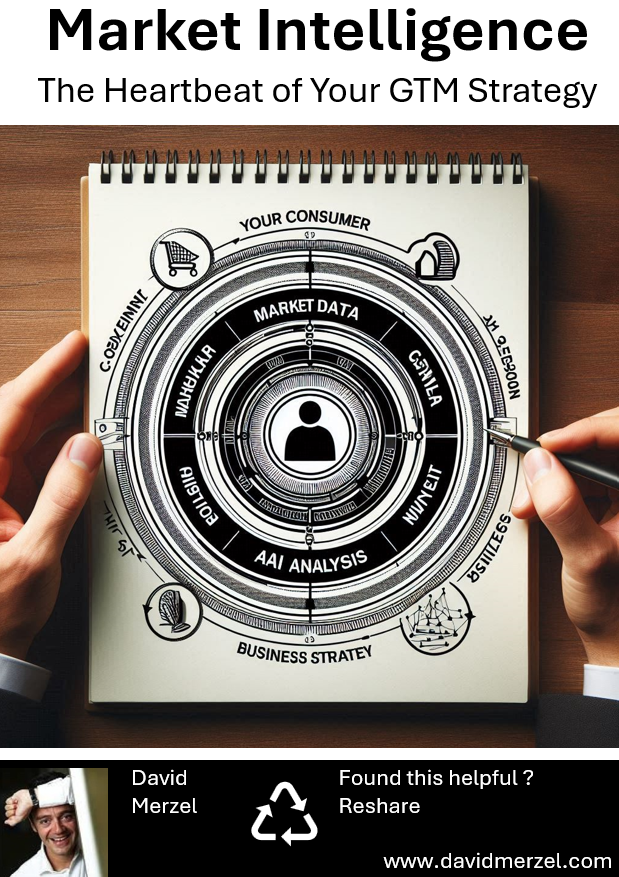
I designed the visual above using Microsoft Designer to illustrate that a successful organization should prioritize the customer at its core.
The Power of Knowledge
My journey into market intelligence began in earnest during my early days at a major FMCG company, tasked with revitalizing a newly acquired food brand. This experience was a crucible that forged my understanding of the true power of market intelligence.
When I first stepped into the role, this food brand was seen as having untapped potential. My boss’s directive was clear: become the category expert and chart a course for the brand’s future. This challenge became the catalyst for a comprehensive, data-driven approach that would shape my career.
The project unfolded in six critical stages:
- Market Analysis: I conducted an in-depth study of market trends using AC Nielsen data. This provided a solid foundation for understanding the current landscape.
- Market Share Projection: Using this data, I simulated the brand’s potential market share over a three-year period. This exercise revealed the need for line extensions to ensure the brand’s sustainability.
- Initial Focus Group: We organized focus groups to understand product usage and attitudes, exploring potential product extensions.
- Concept Development: Based on these insights, we created a concept placing the core product at the center and arranging potential extensions in concentric circles based on their short-term and medium-term viability.
- Growth Plan Development: Leveraging the focus group results, I developed a three-year growth plan. This plan started with the Total Addressable Market (TAM) for each category, projected market share growth, and estimated revenue based on pricing assumptions. We collaborated with Innovation Centers to assess the feasibility of innovations and calculate transfer costs.
- Quantitative Validation: For our first extension, we conducted a quantitative “MicroTest” study. This provided projected unit sales and revenue based on detailed product and marketing mix inputs.
This meticulous approach led to the approval of a three-year plan for a pilot market, featuring three product extensions. The success of this initiative led to my creation of a playbook for launching the brand in other European markets.
This experience taught me the invaluable lesson that market intelligence is not just about gathering data; it’s about transforming that data into a competitive advantage. It’s the art of listening to the market’s heartbeat and anticipating its next move.
Democratizing Insights
As my career progressed, I realized the importance of democratizing insights across an organization. In one of my previous experiences, I spearheaded a project to create a one-stop shop for all data related to the subscription economy and related products.
We began by forming a virtual team to collectively understand the information available from various sources: market data, telemetry data, and financial metrics like Customer Lifetime Value (CLV). This collaborative effort helped us identify gaps and prioritize the information we wanted to democratize.
Once we had a clear picture, we developed a platform to make this information accessible through a single portal. But technology alone wasn’t enough. We also created a comprehensive capability plan to train people on using these insights effectively. To ensure adoption and proper utilization, we appointed change agents in each region who could help drive insights-based decision-making.
The ultimate goal was to feed these insights back to the Business Groups responsible for product development and go-to-market strategies, creating a virtuous cycle of data-driven innovation.
AI-Powered Market Analysis
In today’s AI-driven world, the process of gathering and analyzing market intelligence has been revolutionized, allowing us to gain deeper insights faster than ever before. Let’s explore how some forward-thinking companies are leveraging AI to stay ahead of the curve:
Predictive Analytics
Netflix uses AI-powered predictive analytics to forecast viewer preferences and guide content creation decisions. By analyzing viewing patterns, engagement rates, and even pause points in shows, Netflix can predict which new series or movies are likely to succeed, informing their content strategy and marketing efforts.
Sentiment Analysis
Airbnb employs AI-driven sentiment analysis to monitor customer feedback across various platforms. This allows them to quickly identify and address issues, improving their service in real-time. The insights gained also inform their product development and marketing strategies, ensuring they stay aligned with customer needs and preferences.
Competitive Intelligence
Amazon’s AI algorithms continuously monitor competitor pricing, allowing for dynamic pricing adjustments. This not only helps maintain their competitive edge but also provides valuable insights into market trends and consumer behavior.
The Human Touch in the Age of AI
While AI has undoubtedly transformed market intelligence, it’s crucial to remember the importance of human interpretation. As we discussed in our White Belt chapter, the principles of humility and focus are paramount. AI provides us with powerful tools, but it’s our human intuition and experience that turn data into strategy.
I’m reminded of a project I led for a major FMCG brand. Our AI-powered market analysis tool had identified a potential gap in the market for eco-friendly packaging. However, it was our team’s deep understanding of consumer behavior and regulatory trends that allowed us to translate this insight into a successful product launch.
Integrating AI into Your Market Intelligence Strategy
As we progress through our journey, remember that implementing AI in your market intelligence efforts is not about replacing human insight, but augmenting it. Here are some key steps to consider:
- Define Clear Objectives: What specific market insights are you seeking? How will these inform your GTM strategy?
- Choose the Right Tools: Select AI tools that align with your objectives and integrate well with your existing systems.
- Ensure Data Quality: AI is only as good as the data it’s fed. Implement robust data collection and cleaning processes.
- Develop AI Literacy: Invest in training your team to understand and interpret AI-generated insights.
- Maintain a Human-Centric Approach: Use AI to inform decisions, not make them. Always filter insights through the lens of human experience and intuition.
As we move forward in our Orange Belt journey, remember that market intelligence is not just about knowing your market—it’s about understanding it deeply. In the next section, we’ll explore how to use these insights to define and understand your target audience.
By embracing the power of AI while maintaining our human touch, we can navigate the complex market landscape with the grace and precision of a true martial artist. After all, in both the dojo and the boardroom, victory goes to those who blend discipline with adaptability, and data with intuition.
Citations:
[1] https://ppl-ai-file-upload.s3.amazonaws.com/web/direct-files/23985622/e8e73e1b-5432-4870-b22a-0ea8a72d7da4/book.docx
Engaging with You

As part of this journey, I also want to engage with you, my readers, by sharing portions of the book. Your feedback, comments, and suggestions will be invaluable in shaping the final product. I believe in the power of co-creation and would love to incorporate any specific concepts or ideas you might have. Of course, I will give full credit to any contributions that make it into the book. I will make sure nothing confidential will be published in the book.
Join the Conversation
If you have any suggestions or would like to discuss specific concepts, feel free to connect with me on LinkedIn thru personal messaging. I’m always happy to have a conversation and explore new ideas. Together, we can create something truly special. For collaboration or project discussions, you can also schedule a conversation in my calendar below or connect with me via email at david.merzel@hotmail.com. I look forward to further discussions!


Leave a Reply